

Meta Ads Manager Updates 2026: New Features Every Advertiser Should Know
Review a verified Meta ad transparency update, inspect creative settings, and approve a controlled change without invented feature or performance claims.
A useful Ads Manager update review answers three questions: what Meta actually announced, whether the change is available in your account, and what decision it changes. This guide focuses on ad transparency and a controlled creative review. It does not assume that every account has the same interface or rollout schedule.
The verified 2026 update: ad transparency
Meta updated its AI transparency announcement on June 1, 2026. The update describes a rollout of About this ad, with AI information covering Meta-generated creative and detection of certain third-party AI signals. Advertiser payment information and disclosures can vary with region and ad type. This is an announcement about transparency; it does not establish an automatic performance forecasting tool or an instant statistical testing system.
Inspect one creative setting before changing delivery
Open one draft ad and inspect its creative enhancements. Record the exact options your account offers, their current values, and the resulting preview. Availability is an account-level observation you must make yourself. The worksheet below is a proposed snapshot record, not a screenshot of a verified account.
| Record | What to capture |
|---|---|
| Context | Capture date, region, objective, draft status and placement |
| Control | Exact enhancement label and current enabled or disabled value |
| Preview | Original asset and resulting preview, including crop, text and product details |
| Approval | Named reviewer, decision and approved asset version |
| Boundary | Planned spend ceiling and conditions requiring another review |
If an enhancement alters a product, price, legal disclosure or brand mark, reject that preview and correct the draft. Do not infer how it will affect CPA from its appearance. A hypothesis to test is that a particular enhancement improves qualified response while preserving message accuracy; that hypothesis needs a comparison and a meaningful outcome.
A restart limit that preserves control
Stop wasting ad budget
NovaStorm AI cuts Meta Ads CPA by 30% on average. No complex setup required.
- Save the approved baseline and make one identifiable creative change. Keep objective, audience and offer stable where possible.
- Choose an economic spend ceiling before launch. Define the conversion maturity delay from your own reporting; early results can be incomplete.
- Use a manual approval gate for restart. A proposed operating rule is one restart per reviewed change, followed by a new diagnosis if the same failure recurs. This is a governance choice, not a Meta requirement.
- Compare mature completed outcomes and total creative cost. Do not announce significance from a few early purchases or from a tool badge without its method.
Use the A/B testing guide to separate a test plan from a platform release note. An account feature becoming available does not demonstrate that it improves the campaign.
What NovaStorm can help prepare
Our documented September 2026 MCP recording includes an actual creative-generation workflow and a paused local campaign draft. Its reporting data was synthetic, and the recording did not publish ads or measure external Meta delivery. That engineering episode supports a preparation workflow: generate a candidate, inspect it, and review the draft. It does not establish support for a new Ads Manager interface or an advertising uplift.
Release-note checklist
Before adopting any newly named feature, save its official announcement, publication or update date, eligibility conditions, account-visible control and rollback decision. If the feature has no verifiable announcement and no visible control in your account, it has no place in a release checklist. Keep the review about a concrete decision instead of a list of impressive names.
Published by NovaStorm AI. Worked examples and test fixtures in this article are illustrative, not observed customer results.
Disclaimer: This article was generated with the assistance of AI and reviewed by the NovaStorm AI team. While we strive for accuracy, we recommend verifying specific data points and consulting official sources (linked where available) for critical business decisions.
Ready to automate your Meta Ads?
NovaStorm AI takes full responsibility for your campaigns — from monitoring to optimization.
Start NowMore on Meta platform and automation
Webhooks and Meta Ads: Real-Time Campaign Notifications
Design a Meta Lead Ads webhook receiver with verified access, durable receipt, safe replay and reconciliation; keep unverified spend events separate.
The End of Detailed Targeting Exclusions: What It Means for Advertisers
Replace detailed targeting exclusions with permission-aware audience controls, honest qualification messages and economic approval limits.
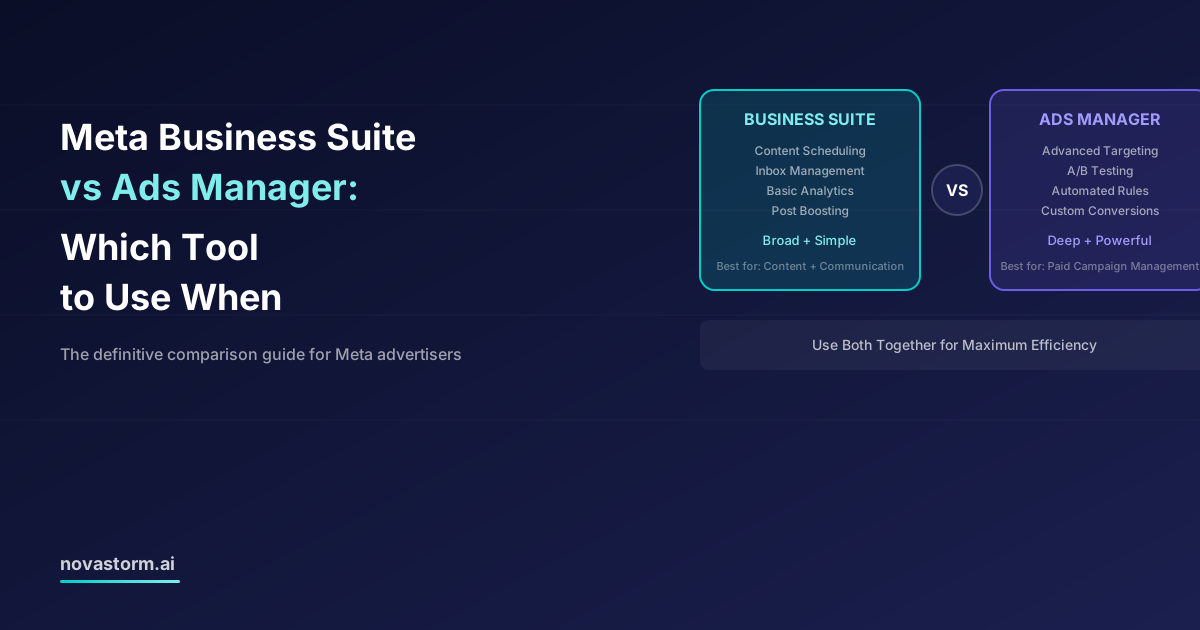
Meta Business Suite vs Ads Manager: Which Tool to Use When
Choose Business Suite or Ads Manager by the booking, publishing, inbox and reporting controls your task requires, with a saved-setting checklist.
Meta Marketing API: Automating Campaign Management at Scale
Build reviewable Meta API operations with a versioned paused campaign example, saved-state checks, dependency handling and careful retry policies.