

View-Through Conversions on Meta: How to Value Impressions
Compare view-through credit with click-only reports while keeping causal lift and mature contribution separate.
A post-impression conversion is advertising credit under a reporting rule. It is not automatically an incremental sale. Compare click-only and click-plus-view reporting with identical scope, then use a valid control experiment when the budget decision requires causal evidence.
Check what the account can report
Consult Meta’s attribution-setting help from the actual account and record the selected event, click window, eligible view/engagement windows and report date. Use available reporting-comparison controls rather than changing delivery settings merely to inspect another view. If a comparison is unavailable, document the exported report definitions. Do not assume a 28-day view option or a universal default.
Aggregate video-view metrics do not establish a customer-level ledger joining percentage watched, impression time and eventual order. Verify what the permitted export actually contains before building weights. Avoid trying to recover private viewer identity from unrelated datasets. No arbitrary engagement discount is used here.
Two comparable reports
| Synthetic same-campaign report | Paid outcomes credited | Credited revenue | Spend |
|---|---|---|---|
| Click-only under recorded window | 80 | USD 4,000 | USD 1,000 |
| Click plus eligible view under recorded window | 100 | USD 5,000 | USD 1,000 |
Illustrative calculation, not observed results: credited ROAS is 4.0 versus 5.0. The difference is 20 outcomes and USD 1,000 of credit under these stated report definitions. Confirm deduplication, attribution priority and whether engagement-through credit is included before naming that difference “view-only.” Never add comparison-window columns unless the source explicitly establishes they are disjoint.
Stop wasting ad budget
NovaStorm AI cuts Meta Ads CPA by 30% on average. No complex setup required.
Neither number is a lower or upper bound on the true incremental effect. Click credit can include people who would have bought without an ad; missing exposures can hide influence. Keep platform credit, reconciled total net sales and causal lift as separate rows.
Why a lift percentage cannot value a view-through share
Suppose, hypothetically, a valid randomized study estimates 15% relative conversion lift and an attribution report assigns 20% of credited purchases to views. Dividing 15 by 20 gives 0.75 arithmetically but says nothing about the share of view-through purchases that is incremental. The percentages use different denominators and the study tests the campaign, including clicks and views, not only the view-credit subset.
A synthetic comparable study has 1,000 assigned users per group: 115 convert under the advertising strategy and 100 in control. The rate difference is 1.5 percentage points; relative lift is 15%. A simple large-sample 95% interval for the rate difference is about −1.21 to 4.21 percentage points, so these inputs do not establish positive lift. The NIST two-proportion reference explains the statistical comparison; validate independence and the actual study method.
Limit the business decision
- Record the exact experiment scope and prevent control exposure through the campaigns being tested. Assess spillover and permitted event capture.
- Include refunds, variable costs, response lag and uncertainty before comparing incremental contribution with spend.
- If the interval includes zero or commercial loss, report an inconclusive result and choose a smaller affordable follow-up rather than inventing a view-credit multiplier.
- Prepare the message and a chosen spend ceiling as a NovaStorm campaign draft, then review the evidence before publication. Reporting comparisons and causal experiments remain in the analytics process.
Published by NovaStorm AI. Worked examples and test fixtures in this article are illustrative, not observed customer results.
Disclaimer: This article was generated with the assistance of AI and reviewed by the NovaStorm AI team. While we strive for accuracy, we recommend verifying specific data points and consulting official sources (linked where available) for critical business decisions.
Ready to automate your Meta Ads?
NovaStorm AI takes full responsibility for your campaigns — from monitoring to optimization.
Start NowMore on Attribution and incrementality
Data-Driven Attribution for Meta Ads: Moving Beyond Last Click
Compare attribution models with a reproducible credit worksheet, then use mature economics and incremental evidence for budget decisions.

Self-Reported Attribution: Asking Customers How They Found You
Use optional self-reported discovery answers with order-linked storage, unknown categories and honest nonresponse reporting.

Marketing Mix Modeling for Meta Ads: Beyond Last-Click Attribution
Prepare aligned weekly data for MMM, inspect identification and calibration, and turn uncertain model scenarios into a contribution-based budget memo.
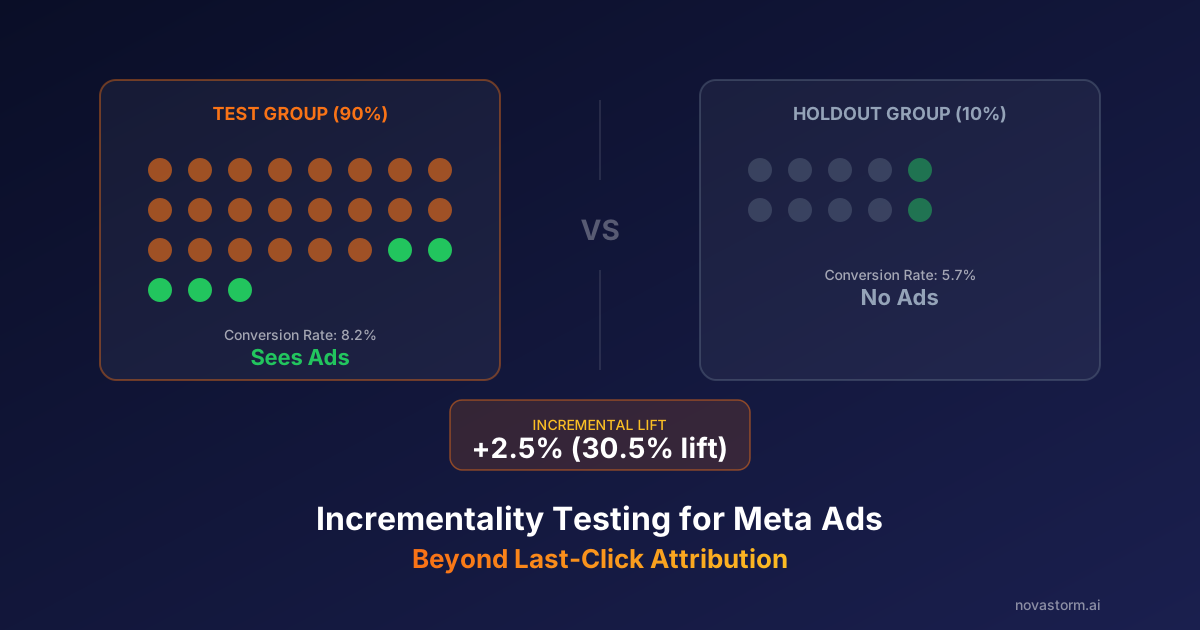
Incrementality Testing for Meta Ads: Beyond Last-Click Attribution
Design an incrementality test with a defined holdout, group-based sample assumptions, effect intervals and contribution economics.