

Video Views Campaigns: Building Retargeting Pools on Meta
Measure a Meta video-view cohort and its downstream value without equating repeated plays, watch percentage or cheap views with qualified customers.

Video-view delivery can serve a viewing job and suggest a retargeting hypothesis where supported. A view, a unique eligible viewer and a customer are different units. Cheap plays do not establish that a large commercially useful audience was created.
Record the viewing definition
Choose the supported objective, location and video performance goal shown in the account. Read its view/ThruPlay definition and denominator before comparing videos; do not assume a longer play means a completed long video. Meta’s video-play reference and saved reporting definition are the relevant contracts.
An illustrative cost check
A fictional campaign spends $150 for 5,000 recorded qualifying plays, giving $0.03 per play. If the available eligible viewer audience has 2,000 unique people, $150 / 2,000 = $0.075 per audience member, before any downstream campaign cost. Repeated plays and audience eligibility explain why those denominators differ. These are examples, not viewing-cost benchmarks.
Choose audience thresholds as hypotheses
Watching 50% of a ten-second clip means five seconds; 50% of a sixty-second clip means thirty seconds. Percentage thresholds across unlike videos are not directly comparable. Inspect available audience rules, geography and business eligibility. A particular 75% view is not proof that someone is ready to buy.
The Engagement outcome guide distinguishes interaction from commercial intent. A viewer may enjoy the content while having no need for the product, so authentic product demonstrations and relevant explanations are more interpretable hypotheses than unrelated entertainment.
Assess the full cost of the follow-up
- Preserve cohort/window and audience-rule definitions.
- Record both view-generation and follow-up advertising costs.
- Reconcile unique mature paid outcomes and customer contribution.
- Account for overlapping audiences and repeated visits.
- Use a supported controlled design if the incremental value of the extra viewing stage matters.
Keep the viewing job distinct from awareness
The awareness measurement guide explains recall and lift questions. A view campaign may contribute useful observations without proving awareness or sales lift. There is no guaranteed ten-to-forty-times-cheaper audience, 15–25% budget requirement or three-to-five-times sequence conversion lift.
Stop wasting ad budget
NovaStorm AI cuts Meta Ads CPA by 30% on average. No complex setup required.
Review the saved creative, audience growth and mature downstream evidence at the agreed allowance. Continue, revise the content or stop based on that evidence. Preparing additional clips or a lookalike is a new hypothesis, not a guaranteed reward for a growing view counter.
Save an audience rule before counting its members
Hypothetical audience setup: use one approved 10-second product demonstration and an assumed 30-day viewing window in an eligible market. Inspect the currently available video source, percentage/duration thresholds and customer exclusions in the account. Save exactly which videos and rules were included; no audience was actually created for this example.
| Video | Assumed rule | Attention represented |
|---|---|---|
| 10 seconds | At least 50% where available | 5 seconds of the chosen clip |
| 60 seconds | At least 50% where available | 30 seconds of the chosen clip |
| Either | Unique matched/eligible viewer count | Not the number of plays and not proof of intent |
Audit uniqueness and eligibility: one person may replay a video, watch multiple videos or appear in multiple audiences. Compare the available unique audience estimate with the rule and date window, document exclusions and privacy constraints, and do not force audience estimates to equal play counts. A small, unavailable or overlapping segment cannot support a clean comparison just because its video generated cheap plays.
Compare the complete path with direct sales delivery
| Hypothetical strategy | Total ad cost | Unique mature paid orders | Calculated all-stage CPA |
|---|---|---|---|
| Video then follow-up | $150 video + $300 follow-up = $450 | 9 assumed | $50 |
| Direct-sale comparison | $450 direct-sale ads | 12 assumed | $37.50 |
The earlier $0.03 per play and $0.075 per audience member do not determine this final comparison. Here the assumed two-stage route costs more per mature buyer. These are constructed inputs, not observed outcomes. Include production, refund-adjusted contribution and shared-channel costs in the business decision. Count each order once even if both stages receive attribution.
To investigate whether the viewing stage adds value, predefine a supported randomized comparison or a justified geographic design against direct-sale delivery, with equal overall cash limits and the same offer. Do not compare self-selected viewers with people who never watched and call it lift. If the audience cannot support the planned precision, stop at an inconclusive result.
Prepare the product demonstration, truthful hook and follow-up brief before a NovaStorm campaign draft. Verify any audience creation separately in Meta. Additional clips and retargeting do not carry a promise of lower acquisition cost.
Disclaimer: This article was generated with the assistance of AI and reviewed by the NovaStorm AI team. While we strive for accuracy, we recommend verifying specific data points and consulting official sources (linked where available) for critical business decisions.
Ready to automate your Meta Ads?
NovaStorm AI takes full responsibility for your campaigns — from monitoring to optimization.
Start NowMore on Campaign structure and objectives

Reach and Frequency Campaigns on Meta: Predictable Delivery for Big Brands
Review reservation eligibility, forecasts, commitments and delivery measurement without promising identical exposure or universal reach guarantees.

Store Traffic Campaigns on Meta: Driving Foot Traffic With Digital Ads
Plan advertising for physical stores with current goal selection, accurate location information and distinct visit, coupon and POS measurement.

Brand Awareness Campaigns on Meta: When and How to Invest at Top of Funnel
Define a Meta awareness hypothesis and measurement plan before committing spend, with current objective naming and limits on proxy conclusions.
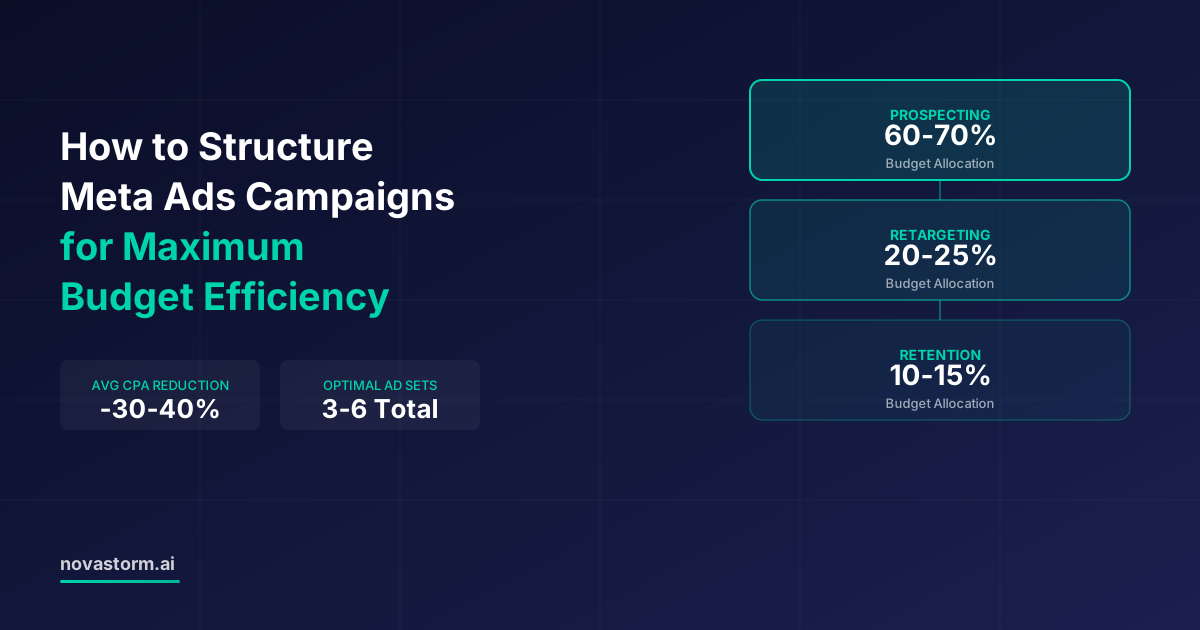
How to Structure Meta Ads Campaigns for Maximum Budget Efficiency
Review each Meta campaign’s job, group separation and budget control without promising CPA savings from consolidation or automatic overlap penalties.