

Store Traffic Campaigns on Meta: Driving Foot Traffic With Digital Ads
Plan advertising for physical stores with current goal selection, accurate location information and distinct visit, coupon and POS measurement.

“Store traffic” describes a business job, not a guaranteed current standalone objective. A retailer may need awareness of a location, directions, inquiries or recorded in-store sales. Those are different actions and require different available settings and evidence.
Select the measurable business action
The objective selection guide helps distinguish visits, leads and sales. The Meta’s official campaign SDK includes current outcome identifiers and some legacy values; their presence is not proof that the old Store Traffic interface or modeled visit reporting is available to your account.
Verify the location information
- Confirm address, opening hours, contact and offer validity.
- Check the actual mobile destination and any directions action.
- Define realistic service geography from customer behavior.
- Prepare truthful store-specific creative and terms.
- Inspect any supported location automation instead of promising nearest-store fields in every setup.
Use the account asset and ownership checklist to establish who maintains location identities, advertising access and datasets. A wrong address or closed-store offer is a confirmed operational problem, even if the platform report looks healthy.
An illustrative promotion record
Suppose a fictional store spends $200, records 80 directions clicks, ten unique coupon redemptions and fifteen matched POS transactions. Directions clicks are not eighty visits. Coupon redemptions can be part of the same fifteen transactions, so do not add ten and fifteen as separate customers. Inspect identity, period and permitted matching before calculating cost per transaction.
Know what each measurement proves
| Observation | Permitted statement | Limit |
|---|---|---|
| Directions click | A recorded navigation action | No confirmed arrival or purchase |
| Coupon redemption | The code was used in a recorded transaction | Code sharing and prior purchase intent remain possible |
| Permitted POS event match | A business transaction matched to the advertising system | Attribution is not causal incrementality |
| Modeled visit metric if available | The platform’s stated estimate | Not a physical headcount or guaranteed availability |
Meta’s Meta’s server event contract supports identifying the action source in a server event. Verify the current integration and data requirements for a physical-store event. Matching and hashing do not create permission to transmit customer data.
Stop wasting ad budget
NovaStorm AI cuts Meta Ads CPA by 30% on average. No complex setup required.
Evaluate the location economics
Include product/service contribution, discounts, returns, capacity and customer quality. A new opening does not universally justify two-to-three-times-normal budget or guarantee higher lifetime value. Weather and hourly patterns can inform a hypothesis, but compare mature equivalent periods before shifting spending.
Report confirmed transactions, chosen attribution and uncertainty separately. If causal additional store demand is the question, use a suitable controlled design. Advertising can support a local offer without pretending that every coupon or modeled visit was caused by the ad.
Reconcile coupon and POS observations before adding results
Illustrative ledger for the earlier assumed $200 promotion: 80 directions clicks are navigation actions. Ten coupon redemptions are included in fifteen unique POS transactions. None of these constructed figures proves incremental store visits.
| Record group | Navigation actions | Coupon redemptions | Unique POS sales | Counting rule |
|---|---|---|---|---|
| Aggregate directions log | 80 | Not linked | Not linked | Do not convert clicks into visits |
| Illustrative transactions T01–T10 | Unknown | 10 | 10 | Coupon and sale refer to the same transaction |
| Illustrative transactions T11–T15 | Unknown | 0 | 5 | Five additional POS sales |
| Unique sale total | Not additive | 10 subset | 15 | CPA = $200 /15 ≈ $13.33; not $200 /25 |
- Store manager verifies the address pin, entrance, local timezone and holiday opening hours; a closed store fails acceptance.
- Offer owner confirms price, validity date, available stock and returns terms. Stop the offer when its promised inventory or appointment capacity is exhausted.
- Measurement owner separates physical headcounts, navigation actions, permitted POS matches and any modeled visit estimate. Keep the model label and its limits visible.
- Record a stable transaction identifier, net sale value, refunds and permitted source evidence in the business ledger; do not transmit unnecessary customer data.
Calculate a sale ceiling after returns
Hypothetical unit economics: a $50 sale less $25 goods cost, $5 variable staffing/fulfillment and $4 expected return/discount cost leaves $16 contribution before advertising. If the owner reserves $3 for overhead and surplus, the sale acquisition ceiling is $13. The illustrative $13.33 CPA is slightly above that chosen ceiling. Real returns, capacity and repeat contribution may change the decision; this is not a store benchmark.
An observed matched sale may have occurred anyway. For additional demand, plan a supported holdout or comparable-store design that handles geography, promotions and spillover; otherwise report the fifteen sales as attributed/matched, not caused. For NovaStorm, prepare a store-specific address/offer brief and review the paused draft with the local owner. This does not imply POS integration or verified footfall measurement.
Disclaimer: This article was generated with the assistance of AI and reviewed by the NovaStorm AI team. While we strive for accuracy, we recommend verifying specific data points and consulting official sources (linked where available) for critical business decisions.
Ready to automate your Meta Ads?
NovaStorm AI takes full responsibility for your campaigns — from monitoring to optimization.
Start NowMore on Campaign structure and objectives

Video Views Campaigns: Building Retargeting Pools on Meta
Measure a Meta video-view cohort and its downstream value without equating repeated plays, watch percentage or cheap views with qualified customers.
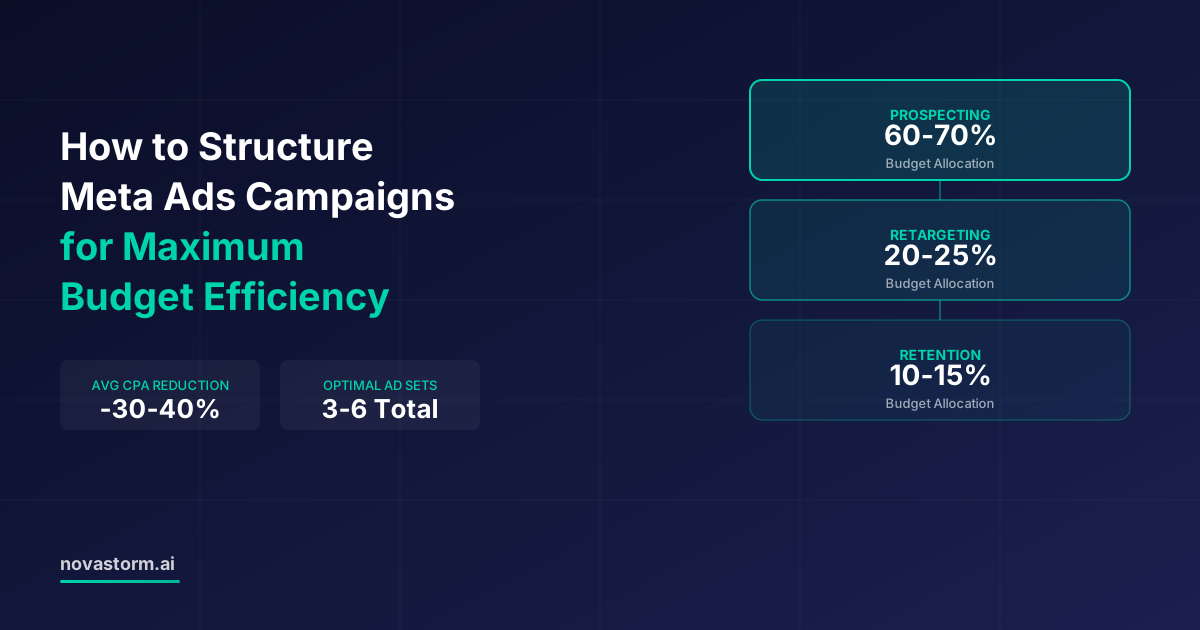
How to Structure Meta Ads Campaigns for Maximum Budget Efficiency
Review each Meta campaign’s job, group separation and budget control without promising CPA savings from consolidation or automatic overlap penalties.

Reach and Frequency Campaigns on Meta: Predictable Delivery for Big Brands
Review reservation eligibility, forecasts, commitments and delivery measurement without promising identical exposure or universal reach guarantees.
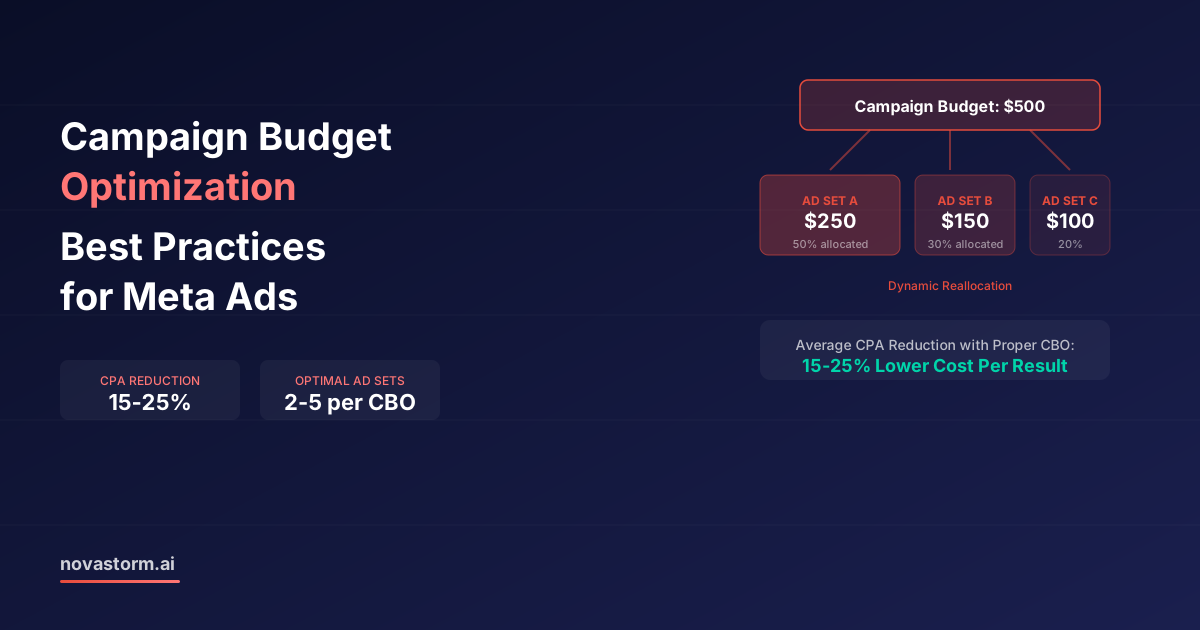
Campaign Budget Optimization Best Practices for Meta Ads
Check a campaign-level Meta budget configuration: shared outcomes, saved limits, dates, pacing and how to diagnose uneven ad-set allocation.