Product-Market Fit and Meta Ads: Why Great Products Win on Paid Social
Discover why product-market fit determines Meta Ads success. Learn to identify PMF signals, test fit through advertising, and know when to iterate your product instead of scaling spend.
Product-Market Fit and Meta Ads: Why Great Products Win on Paid Social
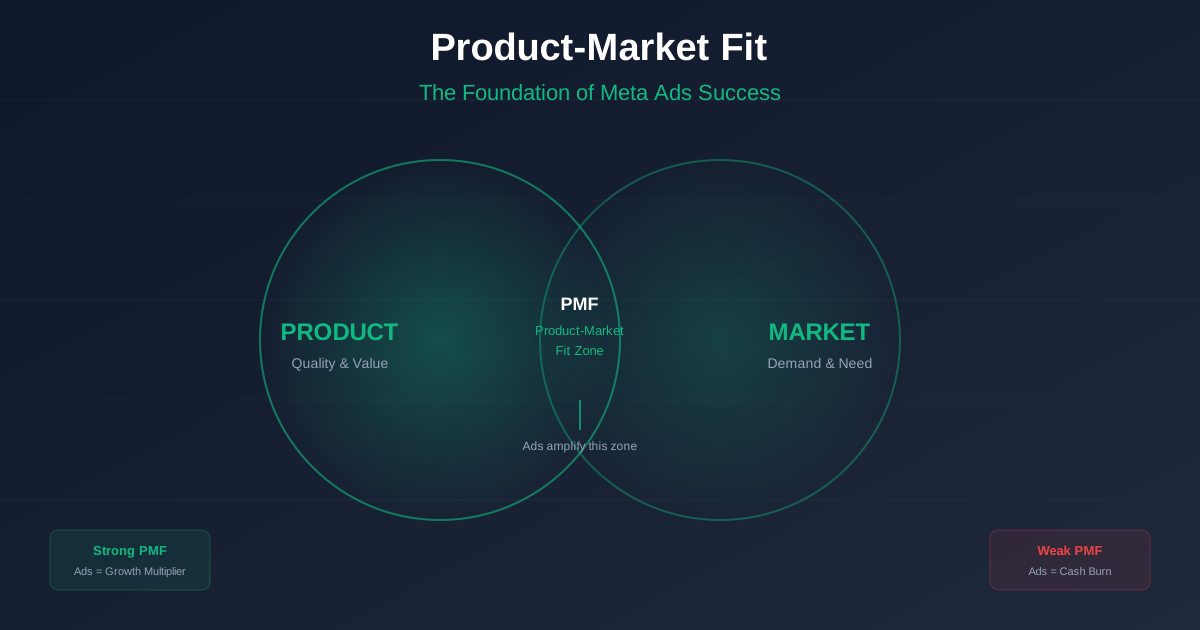
There is an uncomfortable truth in paid advertising that most agencies and media buyers avoid discussing: no amount of creative optimization, audience targeting, or budget scaling can fix a product that the market does not want. Product-market fit Meta Ads performance are inseparable. When your product genuinely solves a problem people care about, advertising becomes a multiplier. When it does not, advertising becomes an accelerant for losing money.
Understanding the relationship between product-market fit and Meta Ads is essential for any business investing in paid social. It changes how you interpret data, allocate budget, and decide whether to scale or pivot. This article breaks down what PMF means for advertisers, how to use Meta Ads as a PMF testing tool, and when to stop advertising and fix your product instead.
Why Advertising a Bad Product Wastes Money Faster Than Anything Else
Meta Ads is an amplification tool. It takes whatever your business offers and puts it in front of millions of people quickly. If your product delights customers, advertising accelerates word-of-mouth, builds brand equity, and drives profitable growth. If your product disappoints customers, advertising accelerates negative reviews, increases refund rates, and burns through cash with nothing to show for it.
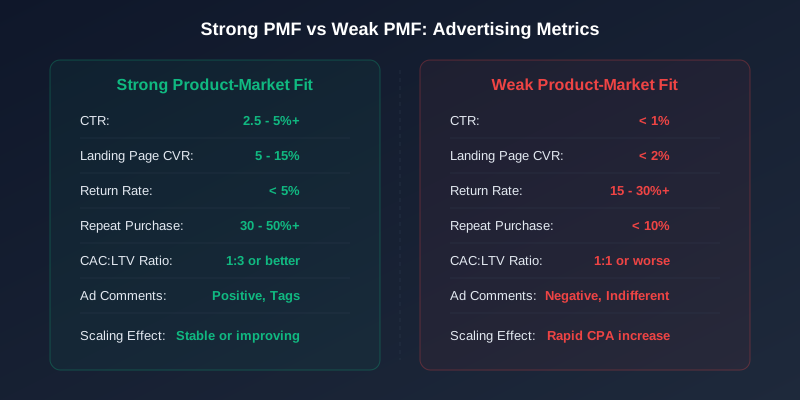
The math is simple. A product with poor product-market fit will have low conversion rates on landing pages, high return rates after purchase, poor customer reviews that tank social proof, low repeat purchase rates that prevent lifetime value from covering acquisition costs, and high customer support costs that eat into margins. Every dollar you spend on Meta Ads driving traffic to a product with these characteristics is a dollar wasted.
Contrast this with a product that has strong PMF. Conversion rates climb because the offer resonates. Return rates stay low because the product delivers on its promise. Reviews are positive, creating a flywheel of social proof. Customers come back and buy again, meaning the lifetime value justifies the acquisition cost. Support costs stay manageable because the product works as expected. Product-market fit Meta Ads campaigns thrive when this foundation is solid.
Recognizing Product-Market Fit Signals in Your Advertising Data
Your Meta Ads data contains clear signals about whether your product has achieved PMF. Learning to read these signals saves you from the trap of optimizing campaigns when the real problem is the product itself.
Strong PMF signals include consistently high click-through rates across multiple creative variations, landing page conversion rates above industry benchmarks, low cost per acquisition relative to your average order value, high add-to-cart rates from cold traffic, positive comment sentiment on your ads, and customers tagging friends in your ad comments. When you see these signals, your product-market fit Meta Ads strategy is working.
Weak PMF signals include low CTR despite testing many creative angles, high bounce rates on landing pages regardless of traffic source, acceptable click-through but very low conversion rates, high cart abandonment even with retargeting, negative or indifferent ad comments, and rapidly declining performance as you exhaust warm audiences. These signals suggest the market is not excited about what you are selling.
Using Meta Ads as a Product-Market Fit Testing Tool
One of the most valuable but underutilized applications of Meta Ads is testing product-market fit before you invest heavily in inventory, development, or infrastructure. Because Meta allows you to reach specific audiences quickly and measure their response precisely, it serves as a rapid PMF testing platform.
Start by creating ads that present your value proposition clearly without heavy discounting or artificial urgency. Run them to cold audiences that match your target customer profile. Measure not just whether people click, but whether they take meaningful action after clicking. A landing page with a waitlist signup, a pre-order option, or even a simple email capture can validate demand before you build or stock anything.
The key to product-market fit Meta Ads testing is isolating the variable. Do not run fancy creative or aggressive offers during the testing phase. Use straightforward messaging that describes what the product does and who it is for. If the raw value proposition does not generate interest, better creative will not save it. It will only mask the problem temporarily.
Low CTR as a Product-Market Fit Indicator
Click-through rate on Meta Ads is a surprisingly useful proxy for product-market fit when interpreted correctly. Low CTR across multiple creative variations targeting the same audience suggests that the audience does not find your offer compelling. This is different from low CTR on a single ad, which might just mean that particular creative was weak.
Stop wasting ad budget
NovaStorm AI cuts Meta Ads CPA by 30% on average. No complex setup required.
If you have tested five or more distinct creative angles, each presenting the product from a different perspective, and none of them achieve above-average CTR for your industry, the problem is almost certainly the offer rather than the execution. The market is telling you that what you are selling does not grab their attention strongly enough to warrant a click.
However, CTR alone is not a complete picture. Some products have high CTR because they are curiosity-driven but low conversion because the product does not deliver on the curiosity. The ideal product-market fit Meta Ads signal is high CTR combined with high post-click conversion, indicating that the product is both interesting and valuable.
Offer-Market Fit and Creative-Market Fit: The Layers of PMF
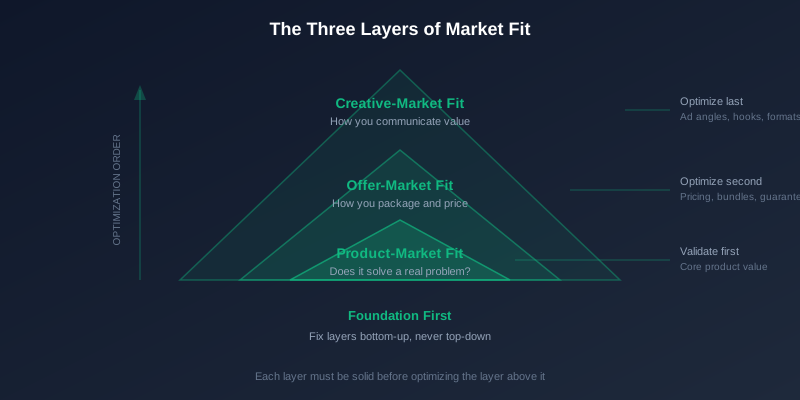
Product-market fit is actually a layered concept when applied to advertising. The base layer is the product itself: does it solve a real problem? On top of that sits offer-market fit: is the way you package and price the product compelling? And on top of that sits creative-market fit: does your advertising communicate the value in a way that resonates?
Many advertisers conflate these layers and try to fix creative when the problem is the offer, or fix the offer when the problem is the product. Understanding the hierarchy is essential. If the product is wrong, no offer structure or creative execution will generate sustainable results. If the product is right but the offer is wrong, better creative might get clicks but conversion will suffer. Only when product and offer are both right does creative optimization unlock its full potential.
Test these layers sequentially. First confirm that your product solves a real problem through customer interviews, reviews, and usage data. Then test different offer structures like pricing, bundling, guarantees, and bonuses through your Meta campaigns. Finally, once you have a validated product and offer, invest in creative testing to find the most effective ways to communicate the value. This layered approach to product-market fit Meta Ads optimization saves enormous amounts of wasted spend.
When to Advertise vs When to Iterate the Product
Knowing when to scale advertising and when to pause and fix the product is one of the hardest decisions in marketing. The data provides guidance if you know what to look for.
Scale advertising when your unit economics are positive, meaning each customer acquired through ads generates more revenue than they cost to acquire over their lifetime. Scale when conversion rates are stable or improving as you increase spend. Scale when customer satisfaction metrics like NPS, reviews, and repeat purchase rates are healthy. These conditions indicate strong product-market fit Meta Ads alignment.
Pause advertising and iterate the product when increasing spend consistently worsens your CPA without improving total profitable revenue. Pause when post-purchase metrics like return rates, support tickets, and review scores are deteriorating. Pause when you cannot achieve profitable customer acquisition even at low spend levels with well-optimized campaigns.
Building Products That Advertise Themselves
The ultimate expression of product-market fit is a product that generates organic demand. When customers love your product so much that they tell others about it unprompted, your advertising becomes a supplement to organic growth rather than the sole driver. This is where the economics become truly favorable.
Products with strong PMF share common characteristics that make them inherently advertisable. They solve a clear, specific problem. They deliver results that customers can see or feel. They create moments of delight that customers want to share. They fit naturally into existing workflows or habits rather than requiring behavior change.
When you have this kind of product, Meta Ads becomes incredibly powerful. Your ads feature real customer stories and results. Your social proof compounds over time. Your retargeting audiences are full of genuinely interested prospects. Your lookalike audiences are built from high-quality seed data. Every element of the advertising machine works better because the underlying product-market fit Meta Ads relationship is strong.
Before you increase your ad budget, ask yourself honestly: does my product deserve more customers? If the answer is yes, scale aggressively. If the answer is not yet, invest that budget in making the product better. The best advertising strategy in the world cannot overcome a product that the market does not want, but a product the market loves makes even mediocre advertising profitable.
Novastorm AI automates Meta Ads routine — from monitoring to optimization. Learn more at novastorm.ai
Disclaimer: This article was generated with the assistance of AI and reviewed by the NovaStorm AI team. While we strive for accuracy, we recommend verifying specific data points and consulting official sources (linked where available) for critical business decisions.
Ready to automate your Meta Ads?
NovaStorm AI takes full responsibility for your campaigns — from monitoring to optimization.
Start NowRelated Articles

AI Funnel Fingerprint Analysis for Meta Ads
Use AI-powered Meta Ads analytics to find funnel drop-offs and automate journey-specific creative for better conversions.

AI-Powered Meta Ads Lead Qualification for Sales
Learn how AI-powered Meta Ads lead qualification and conversation intelligence speed up sales handoff and improve lead quality.

AI Workflows for Cross-Platform Ad Repurposing
Learn how AI-powered Meta Ads creative adapter workflows improve creative repurposing, consistency, and performance across platforms.