

Pricing Strategy in Meta Ads: How to Present Prices That Convert
Present ad prices with honest billing terms, substantiated comparison prices and a test measured through mature paid orders and refunds.
A useful price message tells a buyer what will be charged, what they receive and which conditions matter. Treat presentation as a hypothesis to test. Do not turn arithmetic equivalents, unsupported former prices or learning schedules into misleading savings or outcome promises.
Disclose the full charge before the daily equivalent
| Hypothetical offer | Clear draft wording | Calculation and limitation |
|---|---|---|
| 30-day access, one upfront payment | “30-day access: $99 charged once upfront. Equivalent to $3.30 per day over these 30 days. No automatic renewal.” | 99 / 30 = 3.30; not a daily billing option or calendar-month rate |
| Annual access billed upfront | “12 months of access: $1,188 charged upfront. Equivalent to $99 per month; renewal terms shown before payment.” | 1,188 / 12 = 99; do not imply the buyer can pay $99 monthly |
| One-off course with 14 modules | “14 guided modules. Complete them at your own pace. One payment of $499.” | Module count and content must actually exist; no claim of results within 14 days |
All offers above are invented copy exercises, not NovaStorm prices or verified course specifications. For a real offer, verify currency, billing interval, renewal, cancellation, access term and what the charge includes. Put essential terms with the price in the creative and landing page; inspect mobile crops so they survive export. A daily equivalent cannot replace the actual commitment.
Use a former price only when its history supports it
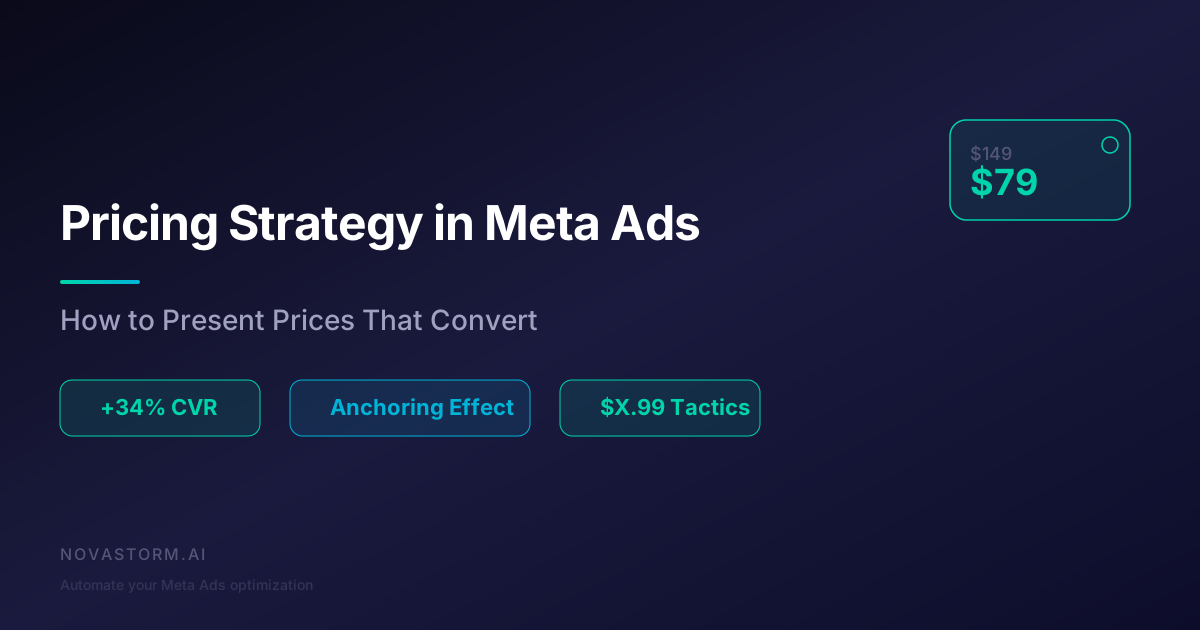
Before striking through $149 and showing $79, retain dated public offer records, eligibility, product/version and how long the genuine former price applied. Distinguish a price previously offered from a price at which substantial sales occurred. If there is no substantiated history, advertise the current price without an invented anchor.
For US advertising, 16 CFR 233.1 on former price comparisons addresses genuine prior offers and fictitious comparison prices. Its context is not a worldwide minimum-duration rule. Have the responsible reviewer check the applicable market and category before approving a savings claim. A competitor reference requires its own comparable product and current source; it is not your former price.
What pricing research does—and does not—show
Wadhwa and Zhang, “This Number Just Feels Right,” Journal of Consumer Research 41(5), 2015 reports five studies of price roundedness and product evaluation. The proposed mechanism concerns fit between feeling-driven or cognition-driven decisions and number processing. It does not establish a universal Meta purchase lift, optimal price ending or test length. Use the research to form a context-specific hypothesis, then measure paid outcomes for your offer.
Stop wasting ad budget
NovaStorm AI cuts Meta Ads CPA by 30% on average. No complex setup required.
Hypothesis: a full-charge headline reduces unsuitable clicks and improves mature contribution compared with an equally disclosed daily-equivalent headline. Keep the same real price, product and checkout terms so you test presentation rather than changing the offer. No proprietary account study or observed uplift is supplied in this article.
Check taxes, refunds and the claimed benefit
- Confirm which market requires tax-inclusive display and whether shipping or unavoidable fees apply. Calculate the final payable amount in that currency and reconcile ad, landing page and checkout. Do not use a single tax rule for every jurisdiction.
- Use the actual refund and cancellation policy, including access already used, deadlines and statutory rights. The copy reviewer should verify the applicable terms; do not invent a money-back promise for the experiment.
- If a course claims a result within a period, require evidence for the described participants, intervention, measurement and expected outcomes. Without that evidence, describe verifiable lessons and access rather than promising a job, revenue or proficiency by day 14.
- Read the exported ad on a phone. If the main price is conspicuous but the billing commitment is unreadable, revise the layout before approving it.
Choose a paid-outcome test, not an arbitrary impression threshold
Before launch specify the assignment method, primary measure, minimum worthwhile effect, affordable spend and completed conversion/refund window. Randomly split comparable eligible people using supported experiment tooling when available; unequal automated ad delivery is not a randomized price-presentation test. Seven days or 1,000 impressions alone cannot establish significance.
Hypothetical calculation: A spends USD 500, receives 20 paid orders and retains 18 after refunds; B spends USD 500, receives 18 and retains 17. With assumed USD 40 contribution per retained order before media, A yields 18 × 40 − 500 = 220, B yields 17 × 40 − 500 = 180. This USD 40 difference is descriptive, not proof that A is better. Include uncertainty, acquisition quality and the full production cost before making a decision.
Prepare approved price variants and their billing conditions in a NovaStorm campaign draft. Review the full offer and destination before publication; use actual order and refund records for the comparison. See offer testing when changing the price or bundle itself.
Published by NovaStorm AI. Worked examples and test fixtures in this article are illustrative, not observed customer results.
Disclaimer: This article was generated with the assistance of AI and reviewed by the NovaStorm AI team. While we strive for accuracy, we recommend verifying specific data points and consulting official sources (linked where available) for critical business decisions.
Ready to automate your Meta Ads?
NovaStorm AI takes full responsibility for your campaigns — from monitoring to optimization.
Start NowMore on E-commerce offers and retention
Win-Back Campaigns on Meta Ads: Re-Engaging Lapsed Customers
Build win-back ads with current customer lists, sustainable discount margins and a control group measuring natural return and second purchases.
Free Shipping Threshold Strategy in Meta Ad Campaigns
Calculate free-shipping thresholds from basket distribution and contribution, then verify the same eligibility in ads, cart and checkout.
Customer Retention Campaigns on Meta: Keeping Buyers Coming Back
Plan customer retention ads using category purchase cycles, verified audience boundaries and incremental repeat-purchase measurement.
Bundle Pricing Psychology in Meta Ads: Perceived Value Tactics
Present bundle contents and savings honestly, calculate contribution including bonuses and returns, and test the offer using paid outcomes.