

Pricing Page Optimization for Meta Ads Visitors
Explain annual charges, trial transitions, discounts and add-ons clearly, test keyboard plan selection, and compare retained contribution rather than clicks.
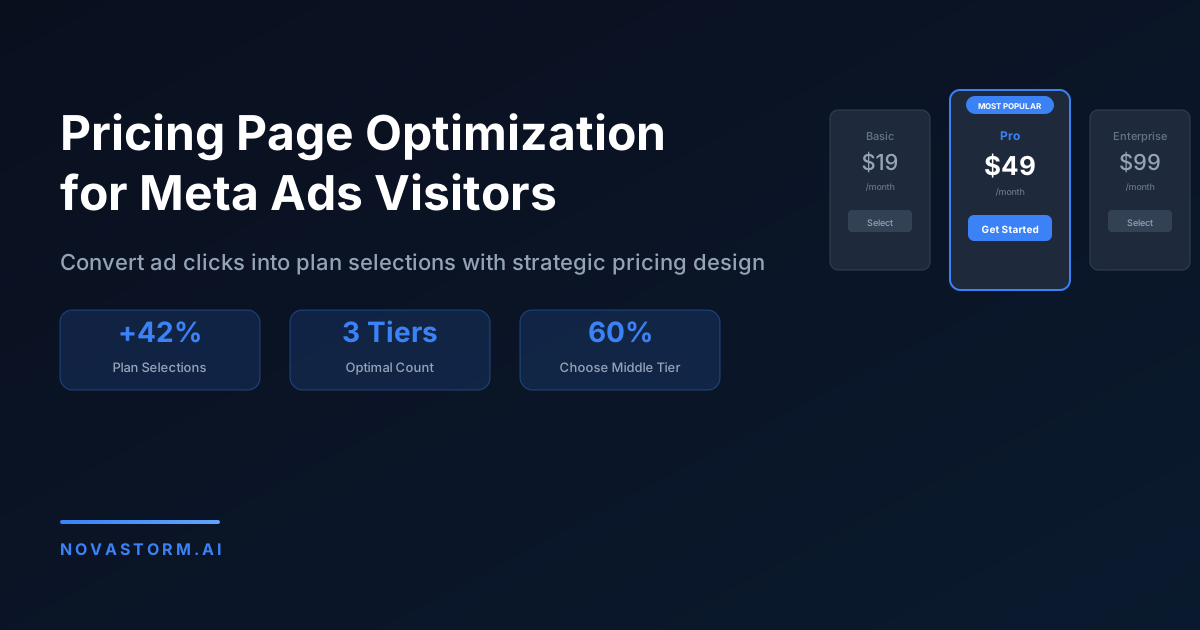
A pricing page should explain the actual charge, billing cycle, inclusions and commitment before asking a visitor to choose. Match those terms to the ad and final order. The number of plans and prominence of a tier are design hypotheses, not guarantees of paid conversion.
A complete teaching tariff panel
Fictional DeskTrail plan, not NovaStorm pricing: the annual plan normally costs $240 per year, equivalent to $20 per month. Assume taxes are not charged in this teaching example. A current first-year promotion gives 25% off the first annual charge; the following panel makes every payment explicit.
| Customer-facing item | Illustrative panel copy |
|---|---|
| Plan and inclusion | DeskTrail Team: shared task lists for up to three users; one guided setup session included. |
| Billing choice | Annual plan: $240 charged once per year, equivalent to $20/month. Monthly alternative: $24 charged each month. |
| Trial | Seven-day trial. Payment details required. No plan charge during the trial; cancel before the stated end time to avoid the first charge. |
| Promotion | 25% off the first annual charge: $180 at trial end, equivalent to $15/month for that prepaid year. |
| Renewal | Renews at $240 per year after the discounted year, subject to the stated terms and any applicable notice. |
| Optional add-on | Extra guided session: $30 one-time, selected separately and not included by default. |
| Cancel and refund terms | Cancellation and refund terms shown before commitment; do not describe an unsupported money-back guarantee. |
The trial start and end timestamps, timezone, eligibility and renewal date must be visible in the real purchase flow. Verify real tax treatment rather than copying the teaching assumption. “$20/month” alone would conceal the annual $240 obligation; the discounted annual $180 is also paid upfront, not as twelve installments.
Trace the selected total
| Hypothetical annual selection | First charge at trial end | Renewal base |
|---|---|---|
| No optional add-on | $180 | $240/year |
| $30 one-time extra session selected | $180 + $30 = $210 | $240/year; no repeat $30 unless separately ordered |
| Promotion ineligible | $240 | $240/year |
For every choice, checkout must agree with the plan panel, eligibility, quantity, currency and optional services. Avoid selecting a paid add-on silently. Record the actual purchased terms with the order; a UI toggle is not proof the billing system accepted them.
Keyboard and selected-plan acceptance
- For a standard radio-group plan selector, Tab enters/leaves the group, arrow keys change the focused and selected choice, and Space selects the focused choice according to the W3C pattern. Prefer native controls when appropriate; test the actual implementation and browser behavior.
- Check that the plan name, checked state, period and full payable total are available to assistive technology. Focus remains visible on narrow screens.
- Move from monthly to annual and back. Verify both the monthly-equivalent label and actual charge update; an annual/monthly switch must not change one without the other.
- Choose and remove the extra session by keyboard. Confirm the $30 inclusion changes the displayed and authoritative first charge exactly once.
- Trigger an eligibility or payment error. Preserve safe selections and announce the correction, then verify accepted order and confirmation using the checkout acceptance checks.
Stop wasting ad budget
NovaStorm AI cuts Meta Ads CPA by 30% on average. No complex setup required.
Use accurate tier labels
A recommendation can say which documented need a plan serves. “Most Popular” needs a defined period, population and actual eligible purchase count showing that it is the most selected relevant plan. If those data do not exist, omit the claim. A selected default or decorative highlight is not evidence of popularity.
Continue beyond 40/20 versus 50/15
Hypothetical equal-size, equal-eligibility cohorts after the same chosen follow-up: A has 40 plan clicks and 20 paid customers; B has 50 clicks and 15 paid customers. The following added assumptions compare contribution, not click volume:
| Synthetic cohort inputs | A | B |
|---|---|---|
| Full refunds by mature follow-up | 2 | 3 |
| Retained customers | 18 | 12 |
| Assumed receipts per retained customer | $100 | $120 |
| Assumed variable cost per retained customer | $40 | $50 |
| Assumed unrecovered refund/support cost | $40 | $60 |
| Media spend | $500 | $500 |
| Contribution after stated costs | 18 × $60 − $40 − $500 = $540 | 12 × $70 − $60 − $500 = $280 |
The example assumes refunded receipts are excluded and refund-related unrecovered costs are listed separately. It does not show an observed layout effect or establish significance. A earns more point-estimate contribution here despite fewer clicks. Keep delayed cancellations and renewals in equally mature cohorts; future receipts are forecasts until observed. See design-specific uncertainty before declaring a winner.
Keep the ad offer consistent
Prepare the approved plan message and billing wording as a NovaStorm campaign draft for review. Validate the price page and billing system with their owners before launch. NovaStorm draft preparation does not reconcile payments or implement the subscription terms described here.
Published by NovaStorm AI. Worked examples and proposed tests are labeled in the article.
Disclaimer: This article was generated with the assistance of AI and reviewed by the NovaStorm AI team. While we strive for accuracy, we recommend verifying specific data points and consulting official sources (linked where available) for critical business decisions.
Ready to automate your Meta Ads?
NovaStorm AI takes full responsibility for your campaigns — from monitoring to optimization.
Start NowMore on Landing pages and conversion
Social Proof Widgets on Landing Pages: Boosting Meta Ad Conversions
Choose proof that answers an offer question, retain source and permission context, and inspect mobile widget behavior without invented conversion claims.

Instant Experience Ads on Meta: Full-Screen Mobile Landing Pages
Assess Meta Instant Experience as an in-app presentation path, verify current account support and measure the handoff to a confirmed business outcome.
Session Recording Analysis for Meta Ads Traffic: User Behavior Insights
Review sampled session recordings with a defined question, tested masking and separate observation, hypothesis and outcome validation.

Above the Fold Optimization for Meta Ads Landing Pages
Audit the first landing-page viewport for truthful message continuity, readable hierarchy and a usable next step across variable mobile conditions.