Pharmaceutical Advertising on Meta: Regulatory Requirements
Master FDA and Meta requirements for pharmaceutical advertising. Complete guide to compliant pharma ads on Facebook and Instagram with approval strategies.
Pharmaceutical advertising on Meta is one of the most heavily regulated forms of digital marketing. Pharma brands operate at the intersection of two demanding regulatory frameworks: the FDA's promotional guidelines and Meta's advertising policies. A single misstep can result in FDA warning letters, Meta account suspensions, or both. Yet the rewards for compliant pharmaceutical advertising on Meta are substantial — the platform provides unmatched reach to patients, caregivers, and healthcare professionals at a fraction of traditional pharma media costs.
This guide covers every regulatory requirement pharmaceutical advertisers must navigate on Meta, from FDA fair balance obligations to Meta's Special Ad restrictions, along with practical strategies for building compliant campaigns that drive meaningful patient and HCP engagement.
FDA Advertising Categories and Their Meta Implications
The FDA classifies pharmaceutical advertising into three categories, each with distinct requirements that directly impact how you structure pharmaceutical advertising on Meta.
| FDA Ad Type | Definition | Key Requirements | Meta Feasibility |
|---|---|---|---|
| Product Claim Ads | Name drug + make efficacy claims | Fair balance, major statement, PI access | Challenging but possible |
| Reminder Ads | Name drug without claims | No efficacy/indication mentions | Easiest to execute |
| Help-Seeking Ads | Describe condition without naming drug | No drug name or branding | Most commonly used on Meta |
| DTC Broadcast-Style | Video ads with product claims | Full major statement, adequate provision | Video format required |
Help-seeking ads are the most commonly used format for pharmaceutical advertising on Meta because they avoid the complex fair balance requirements. These ads describe a health condition and encourage patients to talk to their doctor, without naming a specific medication. They can link to disease-awareness websites that provide educational content and physician finders.
Fair Balance Requirements in Digital Formats
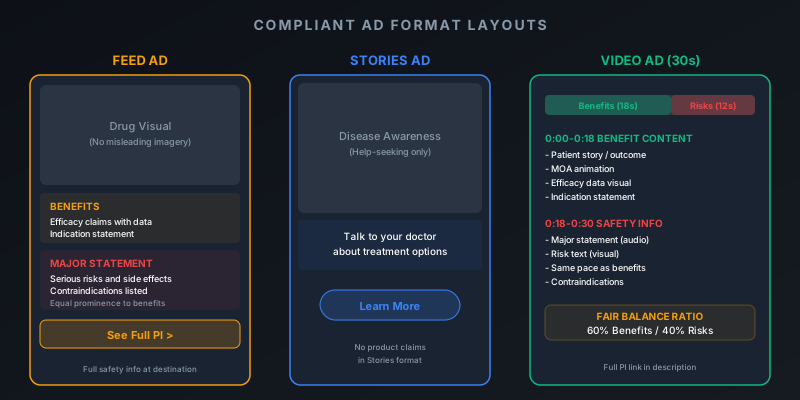
When running product claim ads, the FDA requires fair balance — presenting risk information with comparable prominence to benefit claims. On Meta's formats, this creates significant creative challenges.
For static image ads, include the major statement directly in the ad copy. The primary text field in Meta Ads Manager allows enough space for benefit claims paired with the most serious risks and side effects. Link to the full Prescribing Information (PI) in the ad's destination URL.
For video ads, the major statement must be presented audibly and visually. This typically means dedicating 30-40% of the video duration to risk information. A 30-second video ad should include at least 10-12 seconds of safety information, presented at the same pace and with the same visual emphasis as benefit claims.
Character limits in Meta ad formats do not exempt pharmaceutical advertisers from fair balance obligations. If a format cannot accommodate adequate risk disclosure, you cannot run product claim ads in that format. Stories ads and Reels ads with product claims require careful planning to include required disclosures.
Meta's Platform-Specific Pharmaceutical Policies
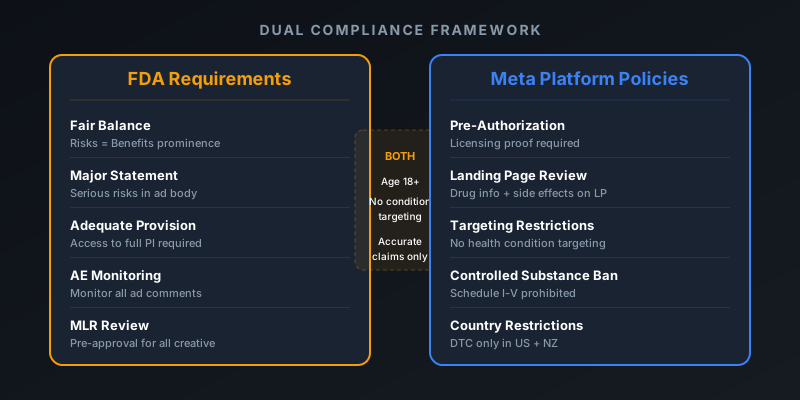
Beyond FDA requirements, Meta imposes its own layer of restrictions on pharmaceutical advertising on Meta. Understanding both sets of rules is essential for campaign approval.
- Pre-authorization required: Pharmaceutical advertisers must complete Meta's authorization process, providing proof of licensing and regulatory compliance before running ads.
- Landing page requirements: All pharmaceutical ad destinations must include clear drug labeling, side effect information, and links to full PI or medication guides.
- Targeting restrictions: Cannot target users under 18 for prescription drug ads. Health condition targeting is restricted; use demographic and behavioral proxies instead.
- Country-specific rules: DTC pharmaceutical advertising is only permitted in the US and New Zealand. Ads targeting other countries must comply with local regulations that typically prohibit direct-to-consumer drug promotion.
- Controlled substances: Ads for Schedule I-V controlled substances are prohibited on Meta, regardless of prescription status.
Compliant Targeting Strategies for Pharma
Pharmaceutical advertising on Meta faces the same health-condition targeting restrictions as other healthcare verticals. You cannot target people based on specific medical conditions. However, pharma brands have unique advantages in building compliant audiences.
Disease Awareness Content Funnel
Stop wasting ad budget
NovaStorm AI cuts Meta Ads CPA by 30% on average. Start free.
Run unbranded disease awareness campaigns that educate patients about conditions, symptoms, and treatment options. These campaigns can target broader wellness and health interests. Build custom audiences from users who engage with this content, then retarget them with branded or help-seeking ads.
HCP Targeting for Professional Promotion
For healthcare professional targeting, use Meta's job title and employer targeting options. Target users with job titles like 'Physician,' 'Nurse Practitioner,' or 'Pharmacist,' combined with employer types like hospitals, clinics, and health systems. Layer in medical publication interests and professional association memberships for refined HCP audiences.
| Audience Strategy | Targeting Method | Best For | Compliance Level |
|---|---|---|---|
| Disease awareness | Broad wellness interests | Unbranded patient education | Fully compliant |
| Engaged patients | Custom audience from content viewers | Help-seeking ads | Compliant with consent |
| HCP targeting | Job title + employer + medical interests | Professional promotion | Compliant |
| Caregiver reach | Parental status + age of dependents | Pediatric/geriatric drugs | Compliant |
| Lookalike expansion | Based on HCP or engaged patient seed | Scale campaigns | Compliant if seed is clean |
Creative Best Practices for Pharma Ads
Pharmaceutical advertising on Meta requires creative that balances regulatory obligations with the engaging, scroll-stopping format expectations of social media. The brands that succeed treat compliance as a creative constraint to work within, not against.
- Use patient storytelling for disease awareness. Real patient experiences (with proper consent and IRB approval if applicable) generate 3x higher engagement than clinical messaging.
- Design safety information for readability, not just compliance. Use clear typography, contrasting backgrounds, and plain language for risk disclosures. Readable safety information actually increases trust and conversion.
- Create format-specific versions. A feed ad can accommodate more text than a Stories ad. Build separate creative sets for each placement rather than relying on automatic cropping.
- Include a clear call to action that complies with FDA guidance. 'Talk to your doctor about [Drug]' is compliant. 'Ask your doctor to prescribe [Drug]' can be considered promotional pressure.
- Test unbranded vs. branded approaches. Many pharma brands find that unbranded disease awareness ads followed by branded retargeting delivers better ROI than branded-only campaigns.
Adverse Event Monitoring on Social Media
Pharmaceutical companies have a legal obligation to monitor and report adverse events (AEs) mentioned in response to their advertising. This requirement extends to comments on Meta ads. When someone comments on your pharmaceutical ad describing a negative experience with your drug, this constitutes a reportable adverse event.
Implement a systematic AE monitoring process. Assign trained pharmacovigilance staff to review ad comments within 24 hours. Use comment filters to flag keywords associated with adverse events. Document every potential AE report with the commenter's description, the drug involved, and the timestamp. Report qualifying events to the FDA within the required 15 calendar days for serious AEs.
Consider disabling comments on pharmaceutical product claim ads to reduce AE monitoring burden. Meta allows comment controls at the ad level. While this reduces engagement, it significantly simplifies pharmacovigilance compliance and reduces regulatory risk.
Regulatory Review Workflow for Meta Ads
Every piece of pharmaceutical advertising on Meta must pass through your Medical, Legal, and Regulatory (MLR) review process before launch. Build a streamlined workflow that enables agility without compromising compliance.
Create pre-approved template libraries for common ad formats and messages. Once the MLR team approves a template, the marketing team can create variations within the approved framework without requiring full re-review. This reduces the typical 4-6 week review cycle to days for standard campaigns while maintaining compliance oversight for new claims or formats.
Pharmaceutical advertising on Meta is complex, but it offers pharma brands an unprecedented ability to reach patients and providers with targeted, measurable messaging. The companies that build robust compliance infrastructure, invest in creative that respects both regulatory requirements and audience expectations, and monitor their campaigns rigorously will capture an outsized share of the patient engagement opportunity that Meta provides.
Novastorm AI automates Meta Ads routine — from monitoring to optimization. Learn more at novastorm.ai
Disclaimer: This article was generated with the assistance of AI and reviewed by the NovaStorm AI team. While we strive for accuracy, we recommend verifying specific data points and consulting official sources (linked where available) for critical business decisions.
Ready to automate your Meta Ads?
NovaStorm AI takes full responsibility for your campaigns — from monitoring to optimization.
Get Started FreeRelated Articles

AI Creative Fatigue Prediction for Meta Ads Scaling
Learn how AI predicts Meta Ads creative fatigue and automates refresh workflows to protect performance while scaling campaigns.

AI Message Match for Meta Ads Conversions
Improve Meta Ads conversions with AI-powered landing page message match automation, analysis, and testing workflows.

AI Budget Pacing for Mid-Funnel Meta Ads
Learn how AI budget pacing and anomaly detection improve mid-funnel Meta Ads performance, reduce waste, and stabilize spend.