Organic Social and Paid Social Synergy: Unified Meta Strategy
Learn how to unify organic social and paid social on Meta platforms. Discover synergy strategies that amplify reach, reduce costs, and drive measurable results.
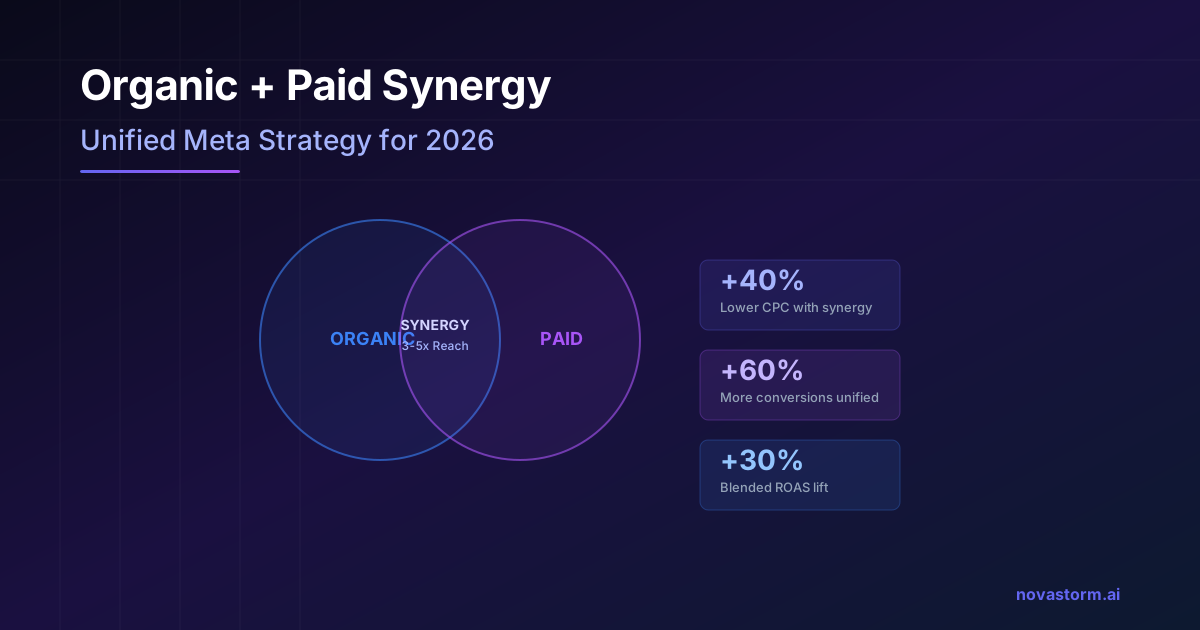
Too many brands treat organic social and paid social as separate channels with separate teams and separate goals. The result is fragmented messaging, duplicated effort, and wasted budget. In 2026, the most effective Meta advertisers have abandoned this silo mentality in favor of a unified approach that makes organic social and paid social synergy the foundation of every campaign.
When organic and paid work together on Meta platforms, the compound effect is powerful. Organic content builds trust and community. Paid amplifies the best-performing messages to new audiences. Together, they create a feedback loop that reduces cost per acquisition, increases lifetime value, and makes every dollar work harder.
Why Organic Social and Paid Social Synergy Matters More Than Ever
Meta's algorithm changes in recent years have steadily reduced organic reach for business pages. The average Facebook Page now reaches roughly 5% of its followers organically. Instagram is slightly better, but the trend is the same. This decline tempts brands to go all-in on paid. But that is a costly mistake.
Paid-only strategies lack the authenticity that modern consumers demand. Organic-only strategies lack the scale. The sweet spot is organic social and paid social synergy, where each channel compensates for the other's weaknesses.
| Metric | Organic Only | Paid Only | Unified Synergy |
|---|---|---|---|
| Average Reach | 5-8% of followers | Defined by budget | 3-5x organic baseline |
| Cost Per Click | Free (but limited) | $0.50-$2.00 | $0.30-$1.20 (lower CPCs) |
| Audience Trust | High | Lower | High at scale |
| Content Velocity | Slow iteration | Fast but expensive | Rapid, cost-efficient testing |
| Data Feedback | Limited signals | Rich but siloed | Complete funnel visibility |
The Framework for a Unified Meta Strategy
Building organic social and paid social synergy requires a structured framework. Without one, teams default to operating independently. Here is a five-step process that top-performing brands follow.
Step 1: Shared Content Calendar
The first step is eliminating separate calendars. Organic posts, paid campaigns, and promotional events should live in a single planning document. This ensures consistent messaging and prevents the all-too-common scenario where paid ads contradict the tone of organic posts published the same week.
Step 2: Organic as a Testing Ground
Treat organic content as a free testing lab. Post multiple creative variations organically. After 48 to 72 hours, identify the top performers by engagement rate, saves, and shares. These winners become your paid creative. This approach consistently reduces cost per result by 20 to 40 percent compared to launching untested creative directly into paid.
Step 3: Paid as an Amplification Layer
Once top organic content is identified, use paid budgets to push it to lookalike audiences and retargeting segments. The content already has social proof in the form of likes, comments, and shares, which increases ad credibility and click-through rates.
Step 4: Unified Audience Intelligence
Combine organic audience insights with paid audience data. Organic followers reveal who already cares about your brand. Paid conversion data reveals who buys. Cross-referencing these segments uncovers high-value lookalike seeds and content themes that resonate across the entire funnel.
Step 5: Closed-Loop Reporting
Measure organic and paid together, not separately. Track how organic engagement lifts paid performance and vice versa. Brands that implement closed-loop reporting discover that organic social and paid social synergy generates 25 to 60 percent more conversions than either channel alone.
Content Types That Bridge Organic and Paid
Stop wasting ad budget
NovaStorm AI cuts Meta Ads CPA by 30% on average. No complex setup required.
Not all content works equally well across both channels. The following formats consistently perform in a unified Meta strategy.
- Short-form video (Reels): High organic reach potential and strong paid performance with completion-rate optimization.
- Carousel posts: Education-focused carousels earn saves organically and drive clicks in paid.
- User-generated content: Authentic reviews and testimonials build trust organically and convert in paid retargeting.
- Behind-the-scenes content: Humanizes the brand organically and performs well as mid-funnel paid creative.
- Interactive polls and questions: Drive organic engagement signals that boost algorithmic distribution, then inform paid messaging.
Common Mistakes That Break the Synergy
Even brands that understand the value of a unified approach make avoidable errors. Here are the most frequent pitfalls.
Mistake #1: Boosting every post. Boosting should be selective, targeting only content that has already proven organic engagement above your baseline. Boosting underperformers wastes budget and teaches Meta's algorithm the wrong lessons about your audience.
Another common mistake is running paid campaigns with completely different creative than what appears organically. When a user sees a polished ad and then visits your profile to find mismatched content, trust erodes. Visual consistency between organic and paid is essential.
Finally, many teams fail to share learnings between organic and paid. If your community manager discovers that a certain topic generates heated discussion, that insight should immediately inform paid targeting and messaging. The reverse is also true. Paid data on high-converting demographics should influence organic content themes.
Measuring Unified Performance
A unified Meta strategy demands unified KPIs. Rather than tracking organic metrics and paid metrics in separate dashboards, combine them into a holistic view.
| KPI | What It Measures | Why It Matters |
|---|---|---|
| Blended CPM | Total spend / total impressions (organic + paid) | Reveals true cost of attention |
| Engagement-to-Conversion Rate | Conversions from users who engaged organically first | Quantifies organic's assist value |
| Content Efficiency Ratio | Paid ROAS of organic-tested vs. untested creative | Proves the testing framework's ROI |
| Audience Overlap % | Overlap between organic followers and paid converters | Identifies untapped segments |
| Share of Voice | Brand mentions vs. competitors across organic and paid | Tracks market position holistically |
How Automation Accelerates Synergy
Managing a unified organic and paid strategy manually is time-consuming. Identifying top organic posts, promoting them at the right moment, adjusting paid budgets based on organic signals, and consolidating reporting across channels requires constant attention.
This is where AI-powered automation changes the game. Platforms that monitor both organic and paid performance in real time can automatically flag top organic content for amplification, adjust paid spend based on organic momentum, and surface cross-channel insights without manual data pulls.
Brands using automated synergy workflows report saving 10-15 hours per week on cross-channel coordination while improving blended ROAS by an average of 30%.
Building Your Unified Meta Strategy Today
Start small. Merge your content calendars this week. Identify your top three organic posts from the past month and test them as paid creative. Set up one shared dashboard that tracks both organic and paid metrics side by side.
From there, build the feedback loops. Create a process where organic insights inform paid targeting weekly. Make paid performance data available to your organic team. Over time, the distinction between organic and paid will blur, and what remains is simply your Meta strategy, unified and powerful.
Organic social and paid social synergy is not a nice-to-have. It is the competitive advantage that separates brands scaling efficiently from those burning budget in silos. The unified approach wins.
Novastorm AI automates Meta Ads routine — from monitoring to optimization. Learn more at novastorm.ai
Disclaimer: This article was generated with the assistance of AI and reviewed by the NovaStorm AI team. While we strive for accuracy, we recommend verifying specific data points and consulting official sources (linked where available) for critical business decisions.
Ready to automate your Meta Ads?
NovaStorm AI takes full responsibility for your campaigns — from monitoring to optimization.
Start NowRelated Articles

AI-Powered Meta Ads Anomaly Detection
Detect spend spikes, delivery drops, and CPA drift in Meta Ads with automated alerts and faster response times.

AI Creative Refresh for Meta Ads That Prevents Stale Performance
Learn how AI creative refresh uses comment and click intent to detect ad fatigue and keep Meta Ads performing longer.

AI-Powered Meta Ads Briefs for Faster Alignment
Learn how AI campaign briefs improve creative-audience alignment and speed up Meta Ads automation for better results.