

Newsletter Growth Through Meta Ads: Subscriber Acquisition Campaigns
Build a consent-aware newsletter signup test, compare confirmed and engaged subscriber cohorts, and calculate an acquisition ceiling from contribution margin.

Newsletter Growth Through Meta Ads: Subscriber Acquisition Campaigns
Paid acquisition is useful only when new subscribers intentionally join, receive the promised content, and produce enough contribution to cover acquisition. This guide builds a signup acceptance test and a cohort comparison; it does not claim a universal subscriber price or a measured campaign improvement.
Choose a signup route and verify the handoff
Compare an on-platform lead form with a newsletter landing page when those conversion locations are available in your advertising account. Use the same newsletter promise and signup eligibility. Neither a lower-friction form nor a longer landing page proves reader quality. Treat “the landing page produces more valuable readers” as a hypothesis, not an assumption.
- State the newsletter topic, sender, frequency and what subscribing means before submission. Distinguish an optional resource request from permission to receive ongoing email; document the applicable consent requirements for your market.
- Record the signup source, timestamp, notice version and contact status in your email system. Keep confirmation status separate from a successful form submission. A thank-you page is not proof that the email system accepted the record.
- Submit a controlled test contact through each route. Verify one contact record, the correct pending/subscribed state, receipt of confirmation where enabled, delivery of the promised issue/resource, and an effective unsubscribe path. Test a duplicate address, invalid address and withdrawal as well.
- If using double opt-in, verify the integration itself sends the confirmation request. Mailchimp notes that its audience double opt-in setting applies to its signup forms; an external form or API integration needs its own implementation check.
Mailchimp describes the confirmation step in its double opt-in documentation. Confirmation can reduce accidental enrollment, but it is not a substitute for clear consent, nor proof of commercial intent.
Define engagement without treating opens as reading
Apple Mail Privacy Protection obscures whether a recipient opened a message. Image loading, blocked images and automated activity also make opens a limited signal. Do not build a “proven reader” segment solely from a 50% open threshold or equate an open-rate change with lost readers.
| Checkpoint | Record | Interpretation |
|---|---|---|
| Signup | Submitted, accepted and confirmed contacts, counted separately | Find form-to-email-system loss before changing targeting |
| Day 7 | Delivered contacts and unique intentional actions: resource download, meaningful reply or confirmed site action | Use the same action definition for both routes; review automated clicks |
| Day 30 | Retained subscribers, paid conversions, refunds and attributable contribution | Allow each cohort the full 30 days; label immature cohorts pending |
Exclude existing subscribers from acquisition where the account supports a suitable audience exclusion and the data use is permitted. Refresh the source after opt-outs and account for upload delay and matching gaps. A matched audience is not your entire subscriber database. Use purposeful clicks, replies or purchases as a potential audience seed only where permission and platform eligibility allow it; do not promise a particular lookalike size or performance.
Make a promise the actual newsletter can deliver
Hypothetical creative brief: a weekly operations newsletter offers “One campaign review checklist and one worked example every Friday.” Show a real sample issue before signup. A template lead magnet should lead into the same recurring topic. Use real, authorized testimonials or verifiable subscriber counts only; otherwise demonstrate the content itself.
Stop wasting ad budget
NovaStorm AI cuts Meta Ads CPA by 30% on average. No complex setup required.
- Angle A: “Review your campaign decisions in 10 minutes with a repeatable checklist.” The time claim must match the actual resource, or use “a short checklist” instead.
- Angle B: “See how a budget decision changes when refunds are included.” Link to a genuine sample calculation.
- Keep the resource, geography and follow-up sequence fixed when comparing routes. Separate a creative test from a form test; do not announce a winner from whichever route has the most cheap submissions.
Work out a margin-based acquisition ceiling
Illustrative assumptions, not observed results: over a chosen 12-month horizon, one confirmed subscriber brings $12 of sponsorship allocation, $8 of subscription contribution before servicing costs, and $4 of affiliate/product contribution. Allocate $10 for editorial production, email delivery, support and expected refunds. Net contribution before acquisition is $12 + $8 + $4 − $10 = $14. These figures are a planning example, not industry benchmarks.
If the owner reserves an assumed $6 for uncertainty and desired surplus, the acquisition ceiling is $14 − $6 = $8 per confirmed subscriber. Change the horizon and reserves for your cash constraints. Count production and service costs once: if a revenue stream is already stated after its costs, do not subtract those same costs again. Forecast revenue is uncertain until the cohort matures; do not use gross lifetime revenue as spend permission.
| Hypothetical route | Ad spend | Confirmed subscribers | Day-30 useful actions | Cost per confirmed / useful action |
|---|---|---|---|---|
| Instant form | $600 | 150 | 30 | $4 / $20 |
| Landing page | $600 | 100 | 35 | $6 / about $17.14 |
The instant form is cheaper per confirmed subscriber in this assumed example, while the landing page is cheaper per useful action. Neither row proves profitability: compare actual 30-day contribution and later payback, subtract content/service costs and refunds, and avoid double-crediting a purchase to both routes. No $2–5 benchmark, 50–70% form saving or automatic quality premium is supported by these hypothetical inputs.
Keep percentage points separate from relative changes
Cost per signup = cost per click / signup conversion rate. With assumed CPC $1 and CVR 10%, the calculated cost is $10. Raising CVR to 11% adds one percentage point, a 10% relative increase, and yields $1 / 0.11 = about $9.09. Raising CVR by 1% relatively changes it to 10.1%, giving about $9.90. Reducing CPC by 1% to $0.99 at unchanged 10% CVR also gives $9.90. The similar small-change result is not an exact equivalence: a 1% relative CVR increase reduces cost by about 0.9901%.
Decide after comparable cohorts mature
- Set a total cash cap, the two route definitions, a primary useful action and a cohort maturity date before launch. If traffic is too sparse to distinguish routes, finish with “inconclusive” instead of stretching the budget.
- At day 7, repair delivery or consent defects before judging creative. At day 30, compare confirmed, retained and useful-action costs alongside contribution, uncertainty and refund exposure.
- Continue only if the next cohort fits the margin ceiling and the team can fulfill the promised content. A cheaper lead does not authorize scale when confirmation or revenue quality deteriorates.
Prepare the newsletter promise, approved sample issue and route-specific budget brief before using NovaStorm to prepare a campaign draft. Review the draft and signup handoff yourself before any publication. This workflow does not imply NovaStorm implements email consent, contact syncing or cohort revenue measurement.
Disclaimer: This article was generated with the assistance of AI and reviewed by the NovaStorm AI team. While we strive for accuracy, we recommend verifying specific data points and consulting official sources (linked where available) for critical business decisions.
Ready to automate your Meta Ads?
NovaStorm AI takes full responsibility for your campaigns — from monitoring to optimization.
Start NowMore on B2B and lead generation

WhatsApp Ads on Meta: Click-to-Message Campaign Guide
Check WhatsApp messaging permissions, account eligibility and API costs, then connect human handoff and retained sales to a bounded click-to-message test.
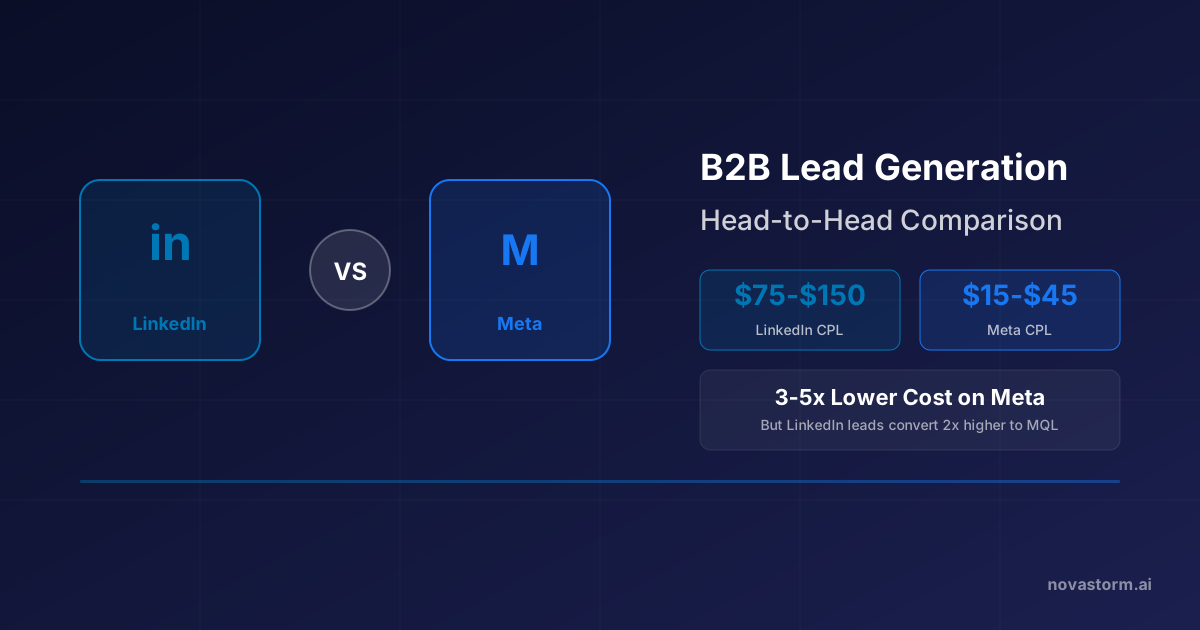
LinkedIn vs Meta for B2B Lead Generation: Head-to-Head Comparison
Compare Meta and LinkedIn B2B campaigns with reachable audience criteria, tagged CRM records, qualification costs and mature paid-customer economics.

Lead Nurturing After Meta Ads: From Click to Customer
Deliver and reconcile Meta leads through a verified intake path, use consent-aware follow-up and compare a proposed nurture sequence with an equal-age control.
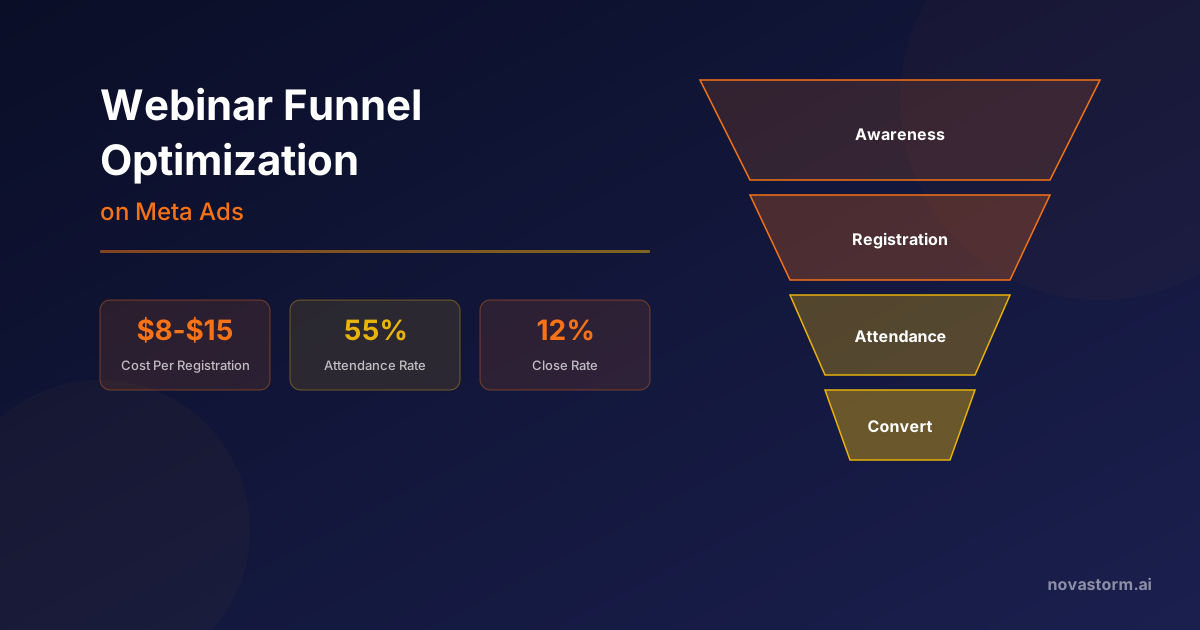
Webinar Funnel Optimization on Meta Ads
Build a webinar campaign with verified registration handoff, deduplicated attendance, complete program costs and mature sales-cohort economics.