Mental Health Services Ads on Meta: Sensitive Topic Marketing
Navigate Meta's sensitive topic policies for mental health advertising. Learn compliant strategies for therapists, clinics, and digital mental health platforms.
Mental health services ads on Meta occupy a uniquely challenging space in digital advertising. On one hand, Meta platforms represent the most effective channel for reaching people who need mental health support — with over 3 billion monthly users scrolling through feeds where emotional vulnerability runs high. On the other hand, advertising around mental health triggers heightened regulatory scrutiny, stricter platform policies, and ethical responsibilities that go beyond standard marketing considerations.
The demand for mental health services has never been greater. One in five adults experiences mental illness annually, yet fewer than half receive treatment. Mental health services ads on Meta can bridge this treatment gap — but only when executed with the right balance of sensitivity, compliance, and performance optimization.
Meta's Policies on Mental Health Advertising
Meta classifies mental health as a sensitive personal attribute. This means you cannot create ads that assert or imply a user has a mental health condition. The difference between compliant and non-compliant copy is subtle but critical.
| Non-Compliant (Rejected) | Compliant (Approved) | Why It Matters |
|---|---|---|
| "Struggling with depression? We can help." | "Online therapy for a better tomorrow." | Cannot assert user has a condition |
| "Your anxiety doesn't define you." | "Professional support when life feels overwhelming." | Cannot imply user has anxiety |
| "PTSD treatment that works." | "Evidence-based therapy for trauma recovery." | Clinical terms need careful framing |
| "Are you depressed? Take our quiz." | "Mental wellness check-in — connect with a therapist." | Cannot use diagnostic questions |
| "Bipolar disorder management." | "Comprehensive mental health care for every journey." | Avoid targeting specific diagnoses |
Meta's automated review system flags mental health keywords aggressively. Even compliant ads may be initially rejected. Always have appeal documentation ready, including your license credentials and a clear explanation of how your ad serves the public interest.
Audience Building for Mental Health Services
Direct targeting of mental health interests or conditions is restricted on Meta. Building effective audiences for mental health services ads on Meta requires creative indirect approaches that reach people likely seeking support without relying on prohibited targeting categories.
Interest-Based Audience Strategies
- Self-improvement and personal development audiences — people actively working on themselves are more receptive to therapy messaging.
- Mindfulness, meditation, and wellness app users — these interests signal openness to mental health support.
- Life transition triggers — recently divorced, new parents, career changers, recent graduates — all correlate with therapy-seeking behavior.
- Health and wellness publication followers — Psychology Today, Headspace, Calm app, wellness podcasts.
- Employee wellness and workplace mental health — professional audiences concerned about burnout and work-life balance.
Content-First Audience Development
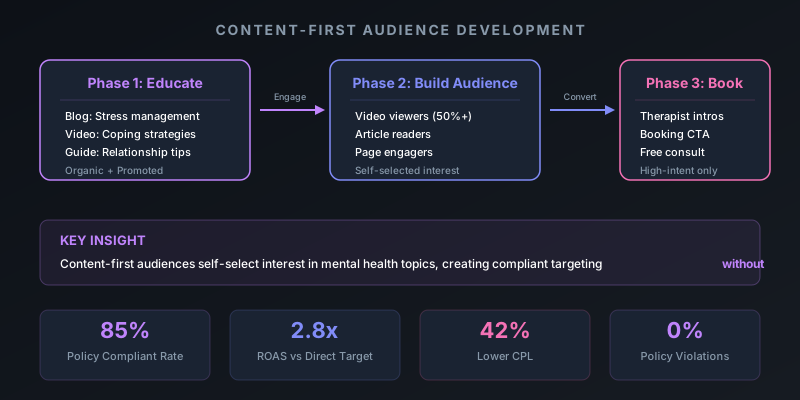
The most effective approach for mental health services ads on Meta is building audiences through educational content. Publish articles, videos, and resources about stress management, relationship communication, or emotional resilience. Then retarget people who engage with this content — creating an audience that has self-selected interest in mental health topics without you needing to target conditions directly.
Creative Approaches That Respect Sensitivity
Mental health advertising creative must walk a fine line between being relatable enough to resonate and careful enough to avoid harmful messaging. The most effective mental health services ads on Meta use empowerment-focused messaging rather than problem-focused messaging.
| Creative Principle | Implementation | Performance Impact |
|---|---|---|
| Hope-forward messaging | Lead with outcomes, not symptoms | +35% engagement vs. problem-focused |
| Normalize seeking help | "Millions choose therapy" social proof | +28% click-through rate |
| Show diverse representation | Multiple ages, ethnicities, genders | +42% relevance score |
| Use calming visual design | Soft colors, natural imagery, open spaces | +20% video completion |
| Provider-centered content | Introduce real therapists and their approach | +55% trust and booking rate |
Video content performs exceptionally well for mental health services. Short therapist introduction videos — where a licensed provider speaks directly to camera about their approach and what a first session looks like — generate 3x more appointment requests than static image ads. The human connection established through video directly addresses the vulnerability patients feel when considering therapy for the first time.
Stop wasting ad budget
NovaStorm AI cuts Meta Ads CPA by 30% on average. No complex setup required.
Campaign Structure for Mental Health Providers
Structure your mental health services ads on Meta around the patient readiness spectrum. Not everyone who sees your ad is ready to book. Some are in early awareness, some are researching options, and some are ready to take action today. Your campaign architecture should serve all three.
- Awareness campaigns using educational video content about common life challenges and the role of professional support. Optimize for video views and engagement. Budget allocation: 30%.
- Consideration campaigns targeting video viewers and content engagers with therapist introductions, service explanations, and client testimonial stories (with proper consent). Optimize for traffic. Budget allocation: 30%.
- Conversion campaigns targeting website visitors and high-intent engagers with direct booking CTAs, insurance information, and first-session offers. Optimize for leads. Budget allocation: 40%.
- Retention campaigns for existing clients promoting additional services like group therapy, workshops, couples sessions, or psychiatric evaluations. Budget allocation: separate from acquisition.
Offer a free initial consultation or reduced-rate first session in your conversion ads. Mental health services see a 60% higher conversion rate when the first-session barrier is lowered, and 80% of trial clients continue with ongoing treatment.
Ethical Considerations and Responsible Advertising
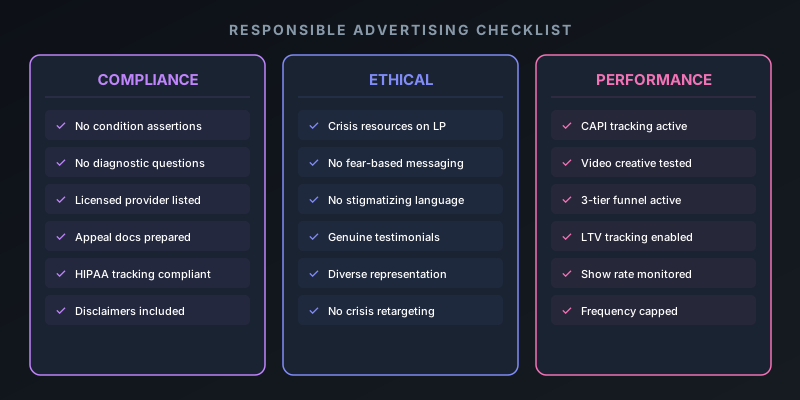
Mental health services ads on Meta carry ethical weight beyond typical advertising. Your ads may reach people in crisis. Every creative decision should be evaluated not just for performance but for potential harm.
Always include crisis resources in your ad landing pages. The 988 Suicide and Crisis Lifeline, Crisis Text Line, and local emergency numbers should be visible on any page linked from a mental health ad. This is not just ethical — Meta reviewers specifically look for crisis resources on mental health landing pages and may reject ads that link to pages without them.
- Never use fear-based or urgency-driven copy for mental health ads. Phrases like 'Don't wait until it's too late' can be triggering.
- Avoid before/after framing that implies mental illness is a visible deficiency that therapy 'fixes.'
- Do not use language that stigmatizes medication, hospitalization, or specific treatment modalities.
- Ensure all testimonials are genuine and include appropriate disclaimers about individual results.
- Never retarget users based on engagement with crisis-related content or resources.
Measuring Success Beyond Cost Per Lead
Standard advertising metrics only tell part of the story for mental health services ads on Meta. Beyond CPL and ROAS, track metrics that reflect the quality of patient acquisition and the long-term health of your practice.
| Metric | Why It Matters | Benchmark |
|---|---|---|
| Cost per Consultation | True acquisition cost after no-shows | $80-150 |
| Show Rate | % of booked who attend first session | 65-80% |
| Continuation Rate | % who book second session | 70-85% |
| 12-Month Patient Value | Revenue per acquired patient | $2,400-4,800 |
| Referral Rate | % who refer others from ad cohort | 15-25% |
Navigating Ad Rejections and Appeals
Expect a higher rejection rate for mental health services ads on Meta compared to other verticals. Meta's automated review system flags mental health terminology aggressively, and even fully compliant ads may require manual review.
Build a rejection response playbook. Document every ad variation with its compliance rationale. When filing appeals, reference Meta's advertising policies by section number, explain how your ad serves the public health interest, and include your organization's licensing credentials. Most legitimate mental health service ads are approved on appeal within 24-48 hours.
Mental health services ads on Meta are among the most impactful forms of advertising. When done right, they connect people in need with professional support that can transform their lives. The marketers who approach this space with genuine care for their audience — combined with smart targeting, sensitive creative, and rigorous compliance — build practices that grow sustainably while making a measurable difference in their communities.
Novastorm AI automates Meta Ads routine — from monitoring to optimization. Learn more at novastorm.ai
Disclaimer: This article was generated with the assistance of AI and reviewed by the NovaStorm AI team. While we strive for accuracy, we recommend verifying specific data points and consulting official sources (linked where available) for critical business decisions.
Ready to automate your Meta Ads?
NovaStorm AI takes full responsibility for your campaigns — from monitoring to optimization.
Start NowRelated Articles
Medical Device Marketing on Meta Ads: B2B and B2C Strategies
Effective medical device marketing strategies on Meta Ads for both B2B hospital sales and B2C consumer devices. Targeting, creative, and compliance guidance.

AI Funnel Fingerprint Analysis for Meta Ads
Use AI-powered Meta Ads analytics to find funnel drop-offs and automate journey-specific creative for better conversions.

AI-Powered Meta Ads Lead Qualification for Sales
Learn how AI-powered Meta Ads lead qualification and conversation intelligence speed up sales handoff and improve lead quality.