

Lead Nurturing After Meta Ads: From Click to Customer
Deliver and reconcile Meta leads through a verified intake path, use consent-aware follow-up and compare a proposed nurture sequence with an equal-age control.

A lead submission needs a reliable receipt, the promised resource and a clear follow-up process. CAPI sends advertising events; it is not a replacement for delivering form submissions into a CRM. Verify the actual lead intake connector or retrieval implementation separately from conversion feedback.
Proposed intake and failure handling
| Stage | Required evidence and identifier | Failure action |
|---|---|---|
| Form submission | Stable source lead identity and authorized fields | Confirm receipt rather than relying on an ad report count |
| Intake connector/retrieval | Source identity, delivery timestamp and result | Retry on a bounded policy; quarantine unresolved failures for an owner |
| CRM acceptance | Source identity mapped to one CRM record | Idempotent upsert; do not create a duplicate on replay |
| Resource delivery | Authorized destination and message status | Separate bounce/failure from sales readiness |
| Sales handoff | Owner, permitted contact channel and relevant requested context | Alert the backup when the agreed response allowance is exceeded |
| Conversion feedback if implemented | Separate event identity and outcome mapping | Reconcile receipt; it does not prove CRM intake succeeded |
This is an implementation design, not an observed NovaStorm integration. In an authorized test environment, submit one synthetic lead, replay delivery, interrupt the connector and recover it. Expect one CRM identity, visible retry history and one intended resource delivery. Test consent denial and an invalid address without silently dropping the lead or sending prohibited messages.
A proposed days 0/1/3/5/7 sequence
The schedule below is a hypothesis, not a universal response-time rule or measured campaign. Adjust it to the person’s requested service, permitted channel and team capacity.
| Day | Message purpose and example | Gate |
|---|---|---|
| 0 | Here is the guide you requested. You can reply with a question. | Deliver the genuine promised resource |
| 1 | Would an explanation of the setup steps help? | Optional marketing only where permitted |
| 3 | See a worked illustrative example, clearly labeled. | Genuine customer evidence only if authorized |
| 5 | Review the checklist before choosing a plan. | Useful standalone content and unsubscribe path |
| 7 | If this fits your needs, review the plan or request a conversation. | Truthful offer; no invented deadline |
Stop wasting ad budget
NovaStorm AI cuts Meta Ads CPA by 30% on average. No complex setup required.
No five-minute multiplier, SMS opening percentage or email benchmark is used. Define and monitor your own staffed response allowance, delivery failures and backlog. A message promise must fit actual team capacity: for an illustrative 40 daily leads requiring ten minutes each, contact work alone needs about 6.67 hours before administration and follow-up.
Providing a phone number is not blanket SMS marketing consent. In this proposed sequence, enable optional SMS only after explicit permission for that channel and applicable legal/provider review; record withdrawal and suppress future messages. ICO guidance explains UK-specific subscriber and electronic-marketing rules; those distinctions are not a global rule for every market.
Compare the sequence fairly
- Define eligible accepted leads before any follow-up. Randomly assign them through a verified method to the proposed sequence or the agreed standard follow-up, preserving required service in both groups.
- Keep source, offer, contact permissions and sales capacity comparable. Analyze original assignment, not only people completing the sequence or buying immediately.
- Declare exposure/service-cost cap, sample plan, maturation period and stopping rule. Primary outcome: retained paying customers or another defined commercial outcome; guards include complaints, opt-outs and response quality.
- Hypothetical equal-size groups of 100 accepted leads: sequence media allocation 1,000 plus service cost 300 with ten retained customers gives full-cost CAC $130; control 1,000 plus 100 with eight gives $137.50. These arithmetic assumptions do not establish significant incremental profit.
- Reconcile refunds, customer identities and actual handling hours. Email opens and clicks are diagnostics, not proof a lead is qualified or that nurture caused the sale.
NovaStorm’s proposed role is preparing the ad promise and campaign material in paused campaign and local ad-set drafts, aligned with the real intake and sales process. No NovaStorm email, SMS, CRM routing or lead-scoring functionality is asserted. The sales handoff guide and lead-quality guide keep acquisition and follow-up definitions consistent.
Published by NovaStorm AI. Planning examples are illustrative assumptions, not measured customer results.
Disclaimer: This article was generated with the assistance of AI and reviewed by the NovaStorm AI team. While we strive for accuracy, we recommend verifying specific data points and consulting official sources (linked where available) for critical business decisions.
Ready to automate your Meta Ads?
NovaStorm AI takes full responsibility for your campaigns — from monitoring to optimization.
Start NowMore on B2B and lead generation

Messenger Ads: Offer, Human Handoff and Paid-Outcome Review
Plan a Messenger ad offer with account eligibility checks, a human handoff queue and mature paid-outcome measurement instead of conversation-price benchmarks.

WhatsApp Ads on Meta: Click-to-Message Campaign Guide
Check WhatsApp messaging permissions, account eligibility and API costs, then connect human handoff and retained sales to a bounded click-to-message test.
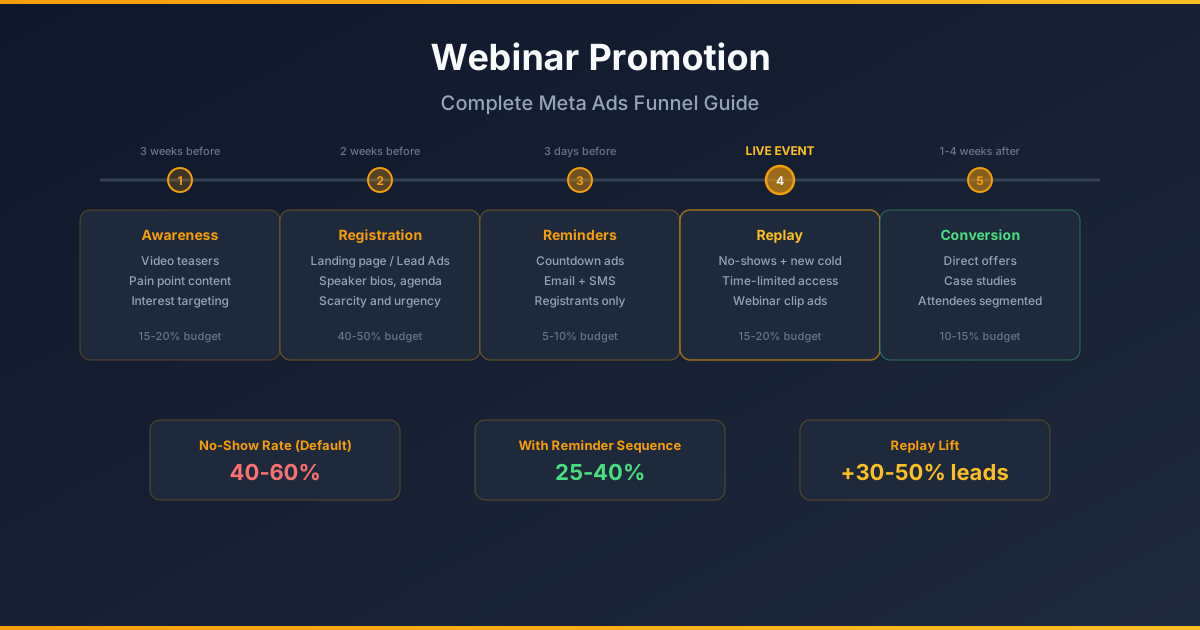
Webinar Promotion Through Meta Ads: Complete Funnel Guide
Budget a webinar funnel with explicit registration and attendance assumptions, verify handoffs and permission, and evaluate mature qualified sales.

Newsletter Growth Through Meta Ads: Subscriber Acquisition Campaigns
Build a consent-aware newsletter signup test, compare confirmed and engaged subscriber cohorts, and calculate an acquisition ceiling from contribution margin.