

Interest Stacking vs Interest Layering in Meta Ads
Understand OR and AND audience math, verify actual expansion controls and compare mature sales quality within an approved budget.
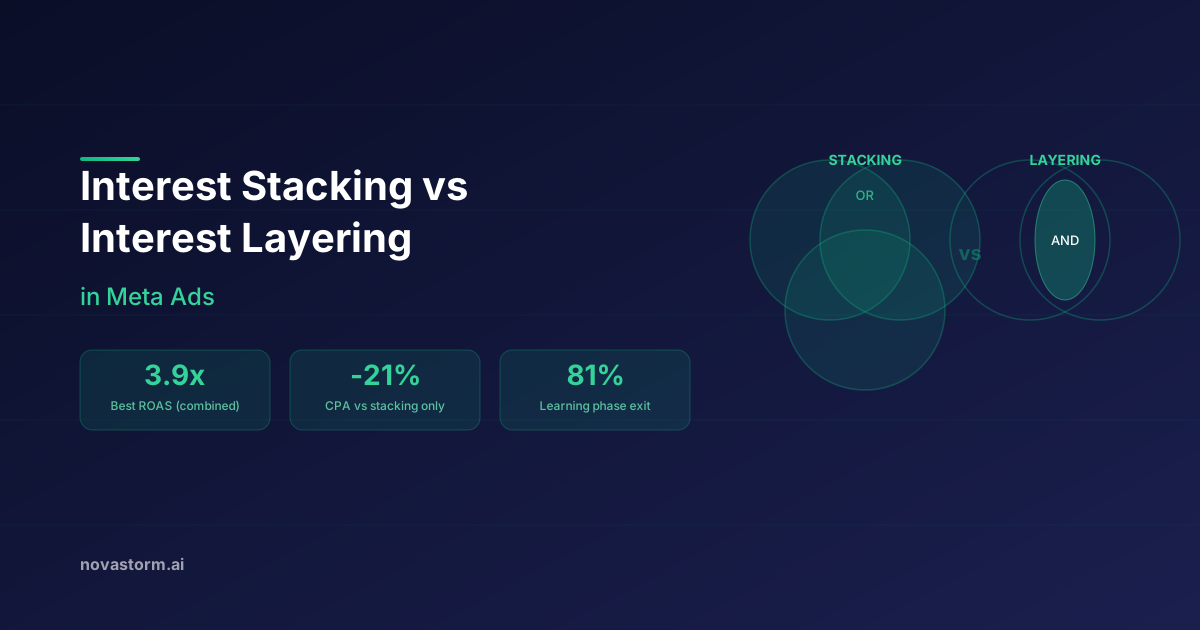
Interest Stacking vs Interest Layering in Meta Ads
OR combines sets and AND intersects them. That logic helps describe an audience hypothesis, but the saved platform controls determine who can actually receive an ad. Availability of interest categories, narrowing and expansion varies; an audience suggestion must not be represented as a guaranteed restriction.
Correct union and intersection arithmetic
Hypothetical set sizes: interest A includes5 million people and B includes3 million in the same hypothetical population of at least 8 million people. Their union A OR B ranges from 5 million (B entirely within A) to 8 million (disjoint sets). Their intersection A AND B ranges from 0 to 3 million. The minimum union is 5 million, not3 million.
For illustration, a fitness hypothesis might be “yoga OR pilates” within one group, and another might be “(yoga OR pilates) AND a separately supported criterion.” Use those names only if the current account actually offers them. An intersection is smaller by set logic; it is not more qualified by definition and does not prove purchase intent.
Save the real configuration for each hypothesis
| Proposed configuration | Acceptance record | Unknown to resolve |
|---|---|---|
| Stack/OR | Available interests, group logic and eligible boundaries | Whether these are controls or suggestions |
| Layer/AND | Actual supported narrowing expression | Narrowing availability and any expansion |
| Broad comparison | Saved geography/age/policy controls and no interest hypothesis | Other optimization/expansion differences |
| All arms | Same offer, event, attribution and total cap | Delivery assignment is not guaranteed random |
Stop wasting ad budget
NovaStorm AI cuts Meta Ads CPA by 30% on average. No complex setup required.
Use the actual account preview/saved settings and current guidance to check Advantage+ expansion. If delivery can extend beyond the stated interests, the experiment concerns that expanded configuration; it cannot establish outcomes for only the named intersection. Do not promise that an unavailable narrowing interface exists.
Measure sales quality under a finite allowance
Illustrative plan: a$450 total budget could support a smaller two-arm question or an exploratory three-arm screen, depending on expected mature orders and required precision. It is not a mandatory $50/day schedule. Neither one million eligible people nor 500 prior events guarantees an answerable comparison.
| Hypothetical mature results | Stack/OR | Layer/AND |
|---|---|---|
| Ad spend | $200 | $200 |
| Unique mature orders | 8 | 10 |
| Calculated CPA | $25 | $20 |
| Contribution after variable costs/refunds | $240 | $180 |
| Contribution less advertising | $40 | −$20 |
In these constructed rows, the lower-CPA layered group has worse contribution because order quality/margin differs. They are not results from 85 accounts. Define unique paid/refund-mature outcomes, customer quality and minimum useful difference before launch. Seven days cannot be a universal maturity rule; use the actual purchase/return cycle and stop inconclusive at the approved cap.
Use a supported controlled comparison for causal configuration claims, or label exploratory delivery as nonrandom. Prepare the saved configuration checklist and approved brief in NovaStorm and have the user review the actual audience behavior before publication. Later observations do not establish that an interest label causes better buyers or authorize automatic scaling.
Published by NovaStorm AI. Worked examples and proposed tests are labeled in the article.
Disclaimer: This article was generated with the assistance of AI and reviewed by the NovaStorm AI team. While we strive for accuracy, we recommend verifying specific data points and consulting official sources (linked where available) for critical business decisions.
Ready to automate your Meta Ads?
NovaStorm AI takes full responsibility for your campaigns — from monitoring to optimization.
Start NowMore on Audience targeting and prospecting
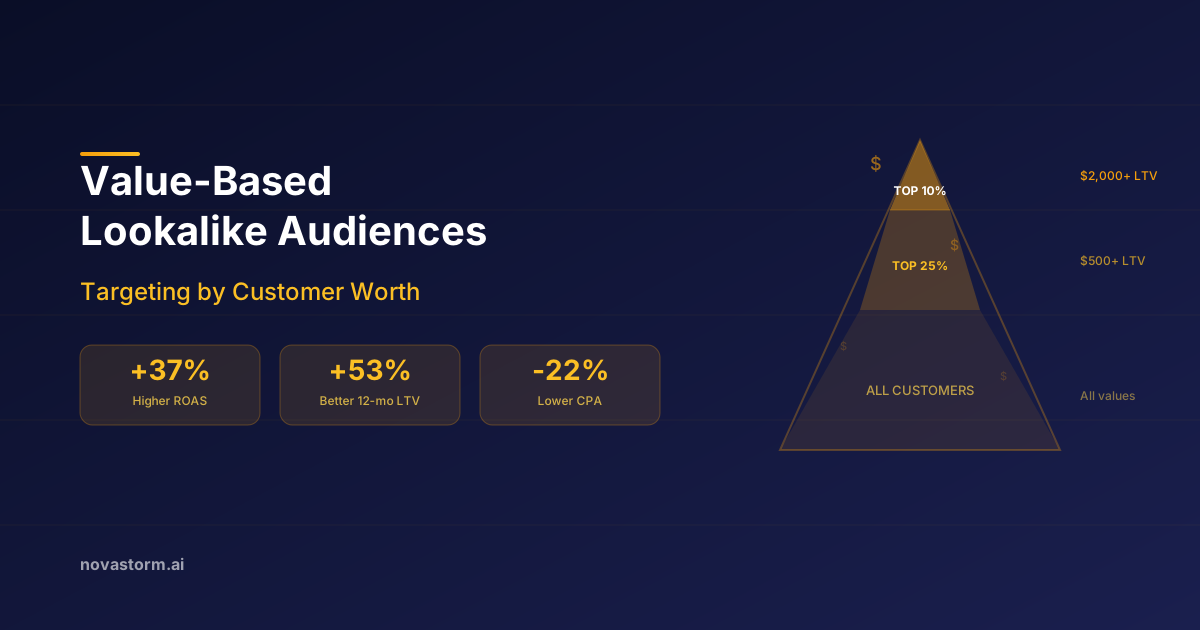
Value-Based Lookalike Audiences: Targeting by Customer Worth
Define permitted customer-value imports, currency and horizon, then compare mature cohort contribution without assuming internal model weights.

Automated Audience Expansion: When to Let Meta Find New Segments
Test audience expansion with enforced service geography, qualified mature outcomes, explicit spend limits and a real assignment plan.
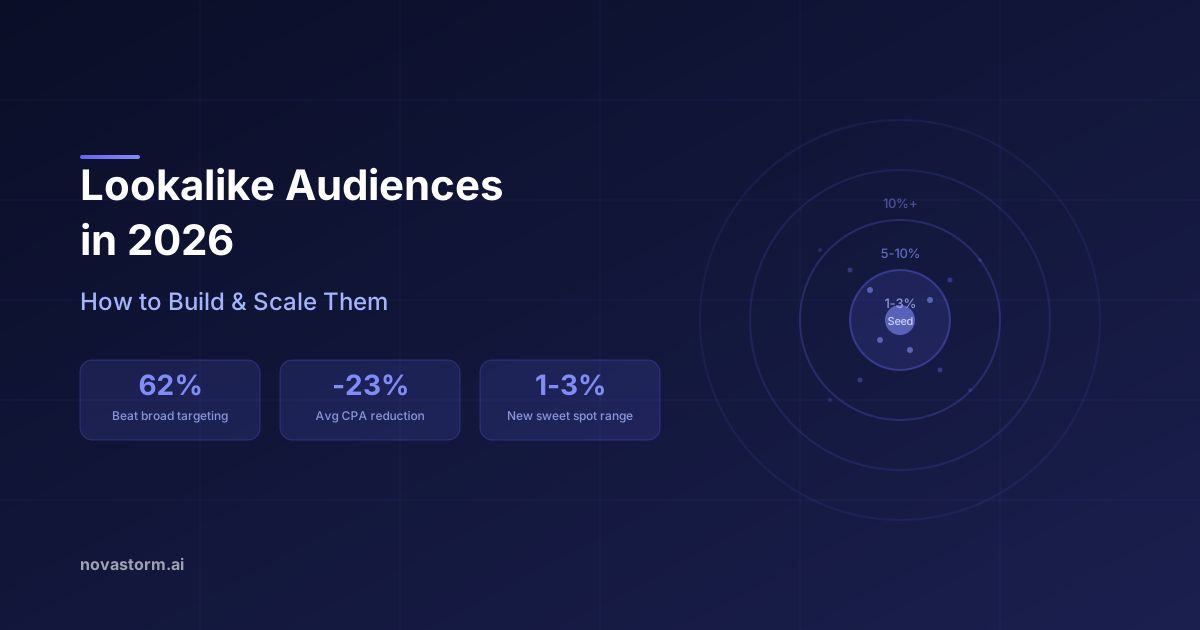
Lookalike Audiences in 2026: How to Build and Scale Them
Validate a permitted lookalike source and saved expansion behavior, then plan mature-order reviews and a total capped budget.
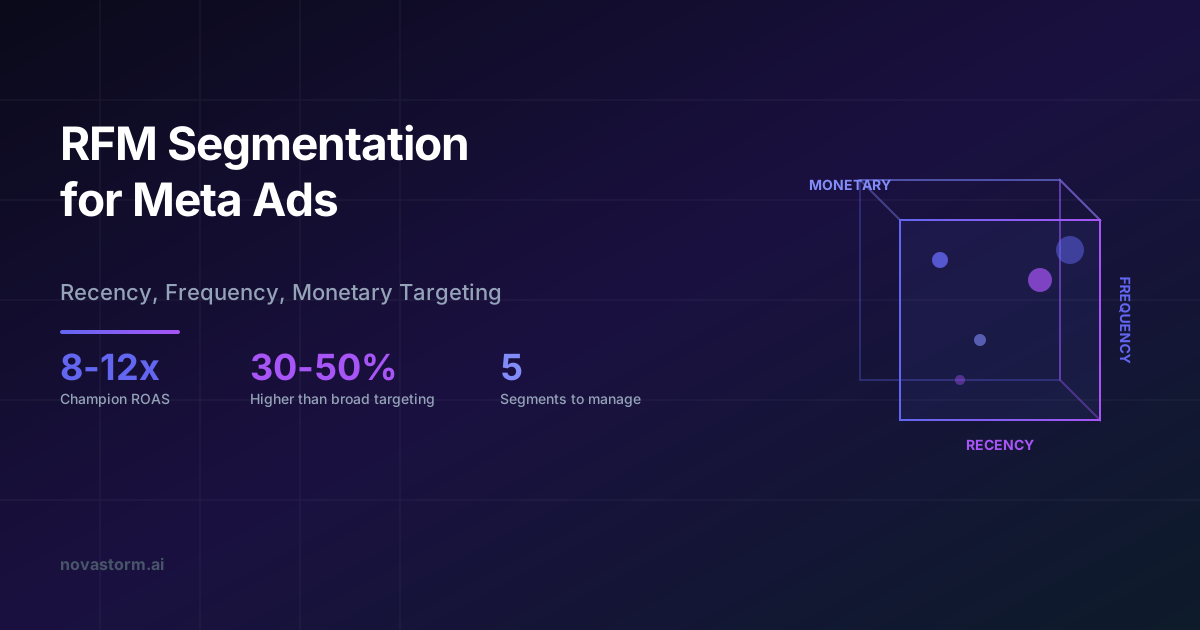
RFM Segmentation for Meta Ads: Recency, Frequency, Monetary Targeting
Learn how to apply RFM segmentation to your Meta Ads campaigns. Target audiences by recency, frequency, and monetary value to maximize ROAS and reduce wasted ad spend.