

Incremental Lift Testing on Meta: Measuring True Ad Impact
Design and interpret a randomized advertising holdout with unequal-group normalization, sample assumptions, uncertainty and a contribution ceiling.

Attribution assigns credit under a reporting rule. An advertising holdout estimates the difference between eligible people assigned to advertising and a comparable control condition. Randomization makes groups comparable in expectation, not identical, and implementation failures can invalidate the causal interpretation.
Check that the intended experiment is available
- Confirm the current account’s eligible lift-study tool, supported outcome, assignment unit, control condition and reporting method with the platform or approved measurement partner. Do not assume every advertiser has the same study control.
- If native tooling is unavailable, choose a separately designed controlled approach with a qualified analyst. Ordinary prospecting versus remarketing reports, alternating days or algorithm-selected ad variants do not create a randomized holdout.
- Verify that assignment is actually enforced, controls are not exposed to the tested campaign, outcome coverage is comparable and other material interventions are documented. Analyze by original assignment, not only people who clicked or received an impression.
Normalize unequal groups before subtracting
The following dataset is hypothetical, not a Meta or NovaStorm study. Assume a valid randomized assignment, comparable collection and mature binary customer outcomes.
| Assigned group | Eligible people | Customers with outcome | Outcome rate |
|---|---|---|---|
| Treatment | 10,000 | 400 | 4.0% |
| Control | 5,000 | 150 | 3.0% |
Rate difference = 4% −3% =1 percentage point. The control rate predicts 300 outcomes for 10,000 treatment-assigned people under the control condition. Estimated additional treatment outcomes =400 −300 =100; subtracting raw counts 400 −150 would incorrectly yield 250. The estimated incremental share is 100 ÷400 =25%; it is not a list of 100 identifiable customers whose individual purchases were proved causal.
Calculate uncertainty and a sample plan
For independent binary outcomes, an illustrative large-sample unpooled standard error is sqrt(0.04 ×0.96 /10,000 +0.03 ×0.97 /5,000) =0.003108. A simple two-sided 95% normal interval for the rate difference is 0.01 ±1.96 ×0.003108, or about 0.39 to 1.61 percentage points. This approximation assumes the stated design and observations; platform or cluster-randomized studies can require a different estimator.
Stop wasting ad budget
NovaStorm AI cuts Meta Ads CPA by 30% on average. No complex setup required.
A planning approximation for equal-size groups uses n ≈2 ×p̄ ×(1−p̄) ×(z₁₋α/₂ +z₁₋β)² /δ². With assumed baseline 3%, target 4%, p̄=3.5%, two-sided α=0.05, 80% power and δ=0.01, it gives roughly 5,300 eligible observations per group. Round and validate with the actual design, estimator and expected coverage; unequal allocation, clustering, multiple comparisons and missing data change the requirement. This is not a universal minimum of 100 control conversions.
The NIST proportion-testing guidance gives the statistical context for binary proportions. A qualified reviewer should select the exact design and sample calculation. Duration must also accommodate enrollment, purchase delay and outcome follow-up; neither two weeks nor a particular holdout percentage fits every account.
Compare lift with the commercial ceiling
Assume study media spend is $2,000 for the treatment-assigned population. At 100 estimated additional outcomes, incremental CPA is $20. Scaling the illustrative rate interval to 10,000 people gives roughly 39–161 additional outcomes, so reciprocal cost spans about $12.4–$51.3 where the denominator remains positive. A $30 contribution-based ceiling is not satisfied confidently by the point estimate alone. Include other acquisition costs and refund maturity consistently.
An interval crossing zero is compatible with negative, zero and positive effects at the tested precision. It may reflect a small or absent effect, sampling noise, or insufficient precision; it does not establish that the ads work and merely need more time. If the incremental estimate is zero or negative, do not present a positive finite incremental CPA as a profitable result.
Record the bounded decision
Before launch, record outcome, assignment, hypothesis, sample assumptions, exposure cap, maturity rule and stopping plan. Inspect balance and delivery compliance, then report the estimate and uncertainty even when inconclusive. Different campaign types can have different audiences and counterfactuals; do not transfer one test’s lift to every budget line.
NovaStorm can support proposed campaign-material preparation in paused campaign and local ad-set drafts. This article does not claim NovaStorm creates randomized holdouts or computes causal lift. Use the holdout guide and contribution ceiling to make the test and finance questions explicit.
Published by NovaStorm AI. Planning examples are illustrative assumptions, not measured customer results.
Disclaimer: This article was generated with the assistance of AI and reviewed by the NovaStorm AI team. While we strive for accuracy, we recommend verifying specific data points and consulting official sources (linked where available) for critical business decisions.
Ready to automate your Meta Ads?
NovaStorm AI takes full responsibility for your campaigns — from monitoring to optimization.
Start NowMore on Attribution and incrementality
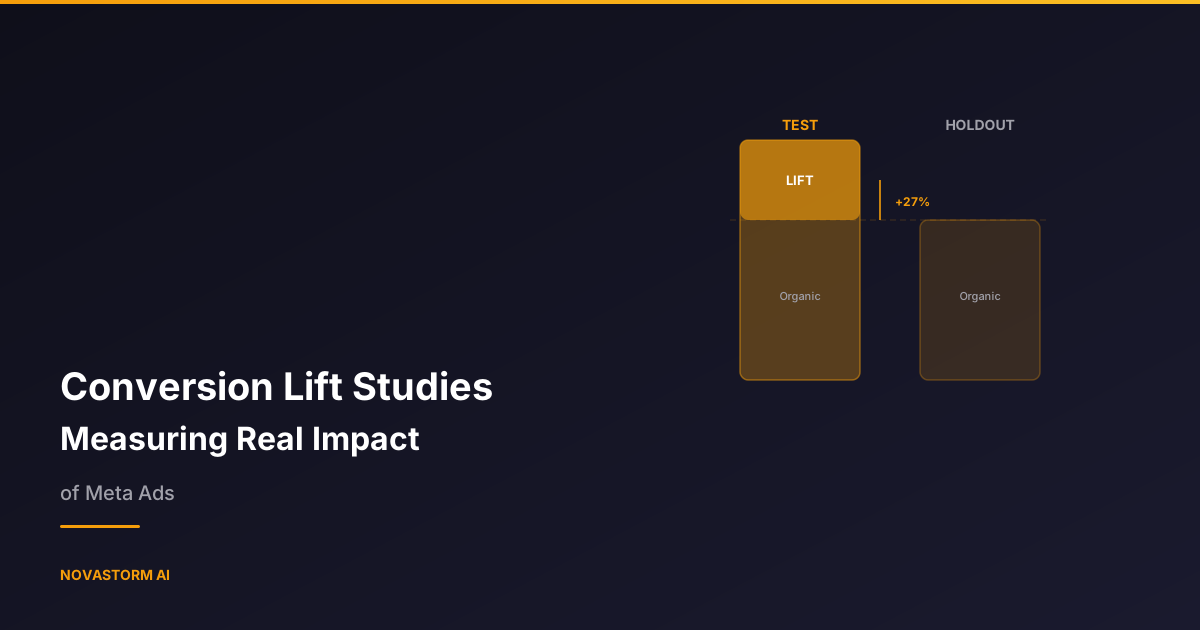
Conversion Lift Studies: Measuring Real Impact of Meta Ads
Normalize unequal holdout groups, calculate incremental conversions and revenue, and interpret uncertain lift before changing the budget.
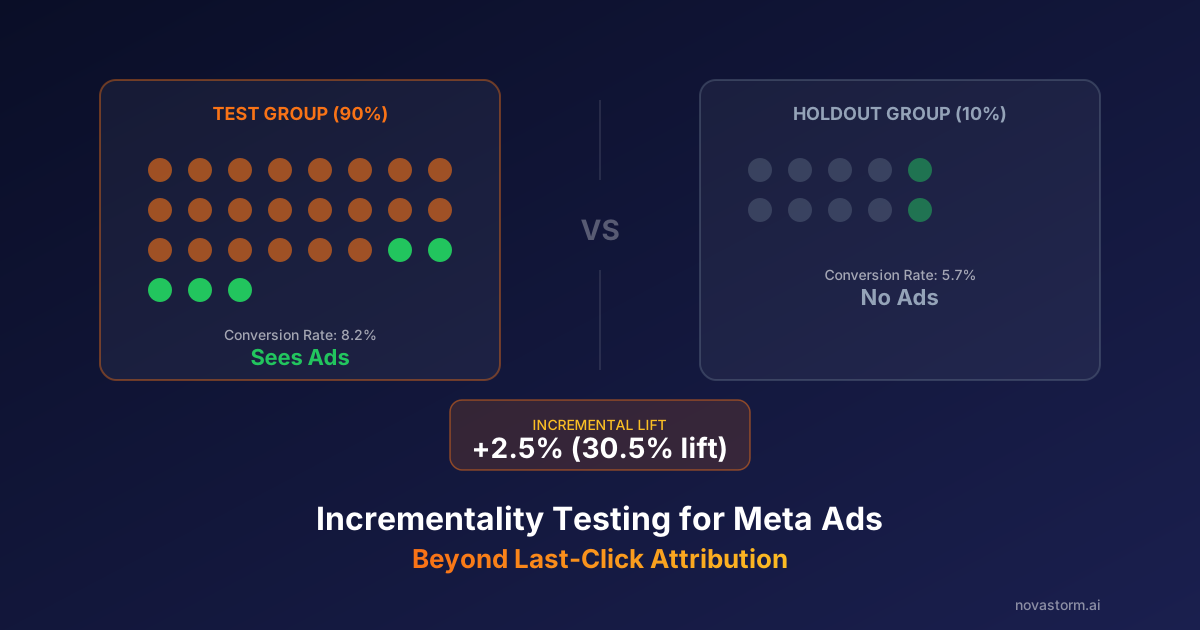
Incrementality Testing for Meta Ads: Beyond Last-Click Attribution
Design an incrementality test with a defined holdout, group-based sample assumptions, effect intervals and contribution economics.
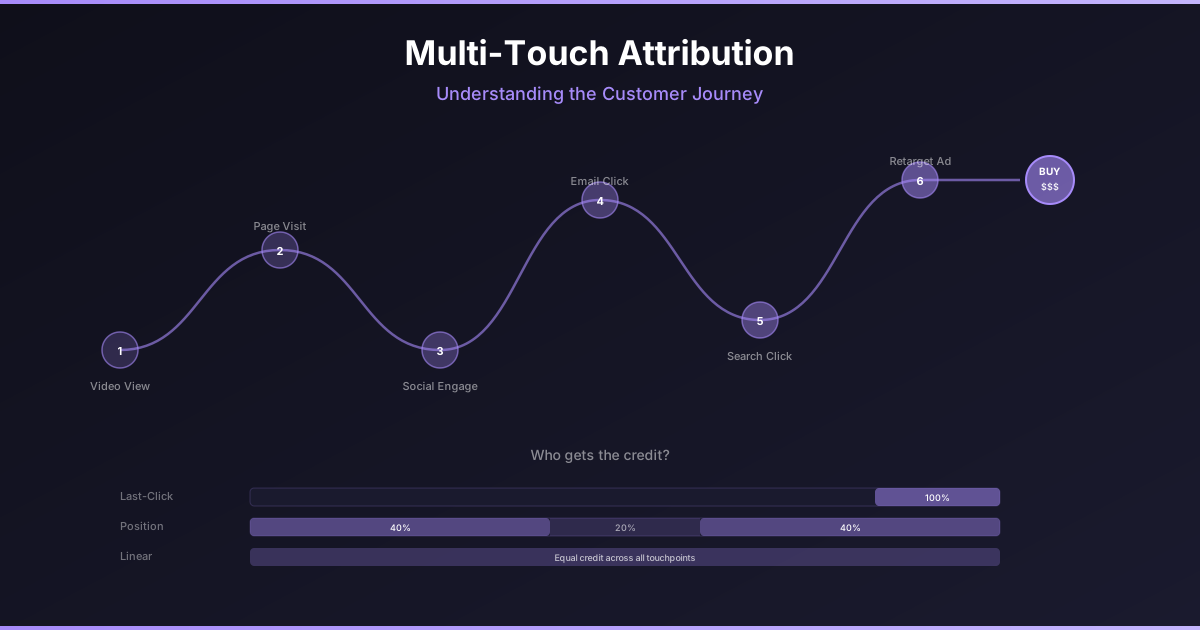
Multi-Touch Attribution: Understanding the Customer Journey in Meta Ads
Reconcile customer paths and orders across channels, compare attribution rules, and keep budget decisions separate from assigned credit.

Marketing Mix Modeling and Meta Ads: Budget Allocation Science
Build a defensible MMM budget scenario: inspect channel identification, seasonality, held-out predictions, uncertainty and contribution margin.