Healthcare Advertising on Meta: HIPAA Compliance and Performance
Learn how to run HIPAA-compliant healthcare advertising on Meta Ads while maximizing patient acquisition performance. Strategies, rules, and optimization tips.
Healthcare advertising on Meta presents a unique paradox: the platform offers unmatched reach to potential patients, yet stringent HIPAA regulations and Meta's own Special Ad Category restrictions create a minefield for marketers. Getting this balance right is not optional. Organizations that fail to comply face fines up to $1.5 million per violation category per year, while those that avoid Meta entirely miss out on a platform used by over 3 billion people monthly.
The good news is that healthcare advertising on Meta can be both compliant and high-performing. This guide breaks down the regulatory landscape, technical requirements, and proven optimization strategies that healthcare marketers need in 2026.
Understanding HIPAA in the Context of Meta Advertising
HIPAA — the Health Insurance Portability and Accountability Act — governs how Protected Health Information (PHI) is collected, stored, and transmitted. When it comes to healthcare advertising on Meta, the primary concern is whether patient data flows from your website or app to Meta's servers through tracking pixels, conversions API, or custom audiences.
In 2024, the HHS Office for Civil Rights issued updated guidance clarifying that standard Meta Pixel implementations on healthcare websites can constitute a HIPAA violation if they transmit PHI. This includes IP addresses combined with health condition pages visited, appointment booking confirmations, and patient portal login events.
Never install a standard Meta Pixel on pages that collect or display patient health information. This includes appointment scheduling pages, patient portals, symptom checkers, and condition-specific landing pages without proper safeguards.
Meta's Special Ad Category Requirements for Healthcare
Meta classifies certain healthcare ads under its Special Ad Categories framework. While healthcare is not a formally designated category like housing or credit, ads related to health conditions, treatments, and pharmaceuticals face additional scrutiny and restrictions.
| Restriction Area | What's Limited | Impact on Targeting |
|---|---|---|
| Age targeting | Cannot exclude age ranges for health-related ads | Broader audience, higher spend required |
| Interest targeting | Health condition interests restricted | Must use broader health and wellness interests |
| Custom audiences | PHI-based audiences prohibited | Use privacy-safe first-party data only |
| Lookalike audiences | Limited when source contains health data | Build from engagement, not patient lists |
| Retargeting | Cannot retarget condition-specific page visitors | Use general site visitors or content consumers |
Building a HIPAA-Compliant Tracking Infrastructure
The foundation of compliant healthcare advertising on Meta starts with your tracking setup. A privacy-first infrastructure allows you to measure campaign performance without exposing patient data.
Server-Side Tracking with Data Filtering
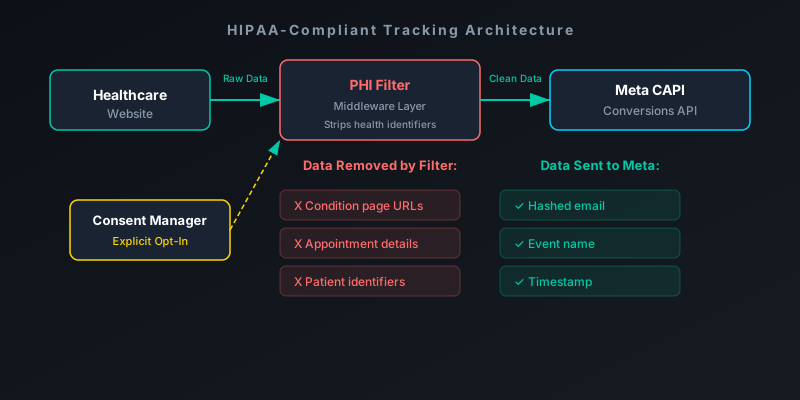
The Conversions API (CAPI) gives you server-side control over what data reaches Meta. Unlike the browser-based pixel, CAPI lets you strip PHI before transmission. Implement a middleware layer that filters out health condition identifiers, appointment details, and any data that could be combined to identify a patient's health status.
Use hashed, non-reversible identifiers for conversion matching. Send only the minimum data required: event name, timestamp, and a hashed email or phone number. Never include page URLs that contain condition names, treatment types, or provider specialties in the event data payload.
Consent Management Implementation
Deploy a consent management platform (CMP) that captures explicit opt-in before any tracking fires. For healthcare websites, this means a clear disclosure that advertising platforms will receive limited interaction data. The consent flow should be granular — allow patients to opt into analytics while opting out of advertising cookies separately.
High-Performing Ad Strategies Within Compliance Boundaries
Stop wasting ad budget
NovaStorm AI cuts Meta Ads CPA by 30% on average. No complex setup required.
Compliance does not mean sacrificing performance. Healthcare advertisers who understand the boundaries can build campaigns that outperform non-compliant competitors who face account suspensions and inconsistent delivery.
- Lead with education, not diagnosis. Ads that offer health information guides, wellness tips, or preventive care resources generate 40% higher engagement than direct service promotions.
- Use provider branding over condition targeting. Instead of targeting people interested in 'diabetes treatment,' position your endocrinology practice as a trusted local provider.
- Build engagement-based audiences. Create custom audiences from video viewers, page engagers, and website visitors (general pages only) to build compliant retargeting pools.
- Test broad targeting with compelling creative. Meta's algorithm optimization often outperforms narrow targeting for healthcare, especially with strong creative and clear calls to action.
- Leverage location targeting aggressively. For healthcare, geographic precision is your most powerful compliant targeting lever — most patients travel under 30 minutes for care.
Campaign Structure for Healthcare Advertisers
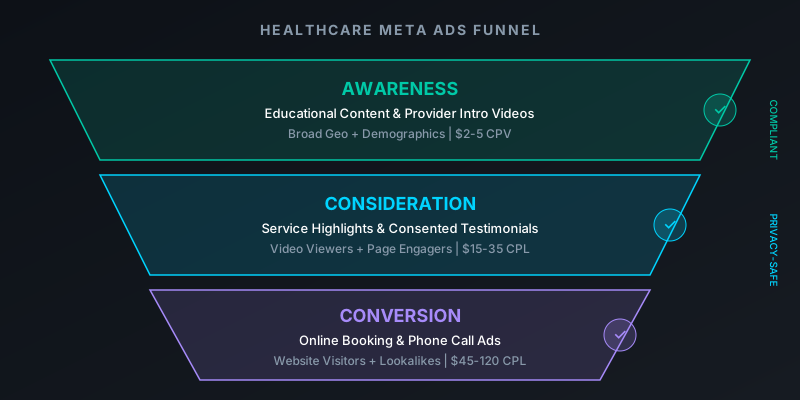
A well-structured campaign architecture separates awareness from acquisition while maintaining compliance at every stage. Healthcare advertising on Meta works best with a three-tier funnel that respects both regulatory requirements and the patient decision journey.
| Funnel Stage | Objective | Targeting | Creative Approach | Avg. CPL |
|---|---|---|---|---|
| Awareness | Video views / Reach | Broad geo + demographics | Educational content, provider intro videos | $2-5 per view |
| Consideration | Traffic / Engagement | Video viewers + page engagers | Service highlights, patient testimonials (with consent) | $15-35 |
| Conversion | Leads / Appointments | Website visitors + lookalikes | Clear CTA, online booking, phone call ads | $45-120 |
This structure ensures that your conversion campaigns only target users who have already engaged with your brand — building compliant audiences organically rather than relying on restricted health-interest targeting.
Measuring Performance Without Compromising Privacy
Attribution in healthcare advertising on Meta requires creative solutions. You cannot simply track a patient from ad click to appointment completion through standard pixel events. Instead, build a measurement framework that combines platform metrics with offline data.
Use Meta's Aggregated Event Measurement (AEM) to capture up to eight conversion events per domain while respecting privacy frameworks. Pair this with call tracking numbers unique to Meta campaigns, UTM parameters analyzed in your CRM (not sent back to Meta), and periodic lift studies comparing ad-exposed geographic areas against control regions.
For multi-location healthcare systems, implement a location-level reporting structure. Each facility should have its own campaign set with dedicated tracking, enabling you to calculate cost-per-patient-acquisition at the practice level without aggregating PHI.
Common Compliance Mistakes to Avoid
Even well-intentioned healthcare marketers frequently make errors that put their organizations at risk. Here are the most common violations observed in healthcare advertising on Meta.
- Uploading patient email lists as custom audiences without a Business Associate Agreement (BAA) — Meta does not sign BAAs for advertising products.
- Using condition-specific URL parameters that get captured by the Meta Pixel, such as /appointments?condition=cardiac.
- Retargeting visitors to symptom-checker or condition-information pages without stripping health identifiers from the event data.
- Including patient testimonials in ads without obtaining HIPAA-compliant written authorization that specifically covers advertising use.
- Allowing Meta's broad targeting expansion to run on campaigns that use health-related ad copy, which can create implied health targeting.
Conduct quarterly audits of your Meta Pixel data using the Events Manager's test events feature. Verify that no PHI appears in the parameters being sent to Meta from any page on your healthcare website.
Healthcare advertising on Meta is one of the most regulated digital marketing disciplines, but it remains one of the most effective patient acquisition channels when executed correctly. Organizations that invest in compliant infrastructure, education-first creative strategies, and privacy-safe measurement frameworks consistently outperform competitors who either avoid the platform or cut compliance corners.
The key is treating compliance not as a constraint but as a competitive advantage. When your tracking infrastructure is clean, your audiences are privacy-safe, and your creative resonates with patients seeking care, Meta's algorithm delivers results that justify the additional effort required to get healthcare advertising right.
Novastorm AI automates Meta Ads routine — from monitoring to optimization. Learn more at novastorm.ai
Disclaimer: This article was generated with the assistance of AI and reviewed by the NovaStorm AI team. While we strive for accuracy, we recommend verifying specific data points and consulting official sources (linked where available) for critical business decisions.
Ready to automate your Meta Ads?
NovaStorm AI takes full responsibility for your campaigns — from monitoring to optimization.
Start NowRelated Articles

AI Funnel Fingerprint Analysis for Meta Ads
Use AI-powered Meta Ads analytics to find funnel drop-offs and automate journey-specific creative for better conversions.

AI-Powered Meta Ads Lead Qualification for Sales
Learn how AI-powered Meta Ads lead qualification and conversation intelligence speed up sales handoff and improve lead quality.

AI-Powered Meta Ads Placement Exclusion Strategy
Learn how AI-powered Meta Ads placement optimization and exclusions can reduce wasted spend and improve campaign performance.