Growth Marketing Framework: Applying AARRR to Meta Ads
Learn how to apply the AARRR pirate metrics framework to your Meta Ads strategy. Map campaigns to Acquisition, Activation, Retention, Revenue, and Referral stages for full-funnel growth.
Growth Marketing Framework: Applying AARRR to Meta Ads
Most advertisers treat Meta Ads as a single-purpose tool: run ads, get sales. But the most successful growth teams use a structured framework to ensure their campaigns serve every stage of the customer lifecycle. The AARRR pirate metrics framework, originally developed by Dave McClure, provides exactly that structure. When you apply AARRR to Meta Ads, you stop thinking in terms of isolated campaigns and start building a growth engine that compounds over time.
Understanding how AARRR Meta Ads strategies work together is critical for any advertiser who wants sustainable, predictable growth rather than a series of one-off wins. This framework forces you to ask the right questions at every stage and build campaigns that feed into each other rather than competing for attention and budget.
What Is the AARRR Framework and Why It Matters for Advertisers
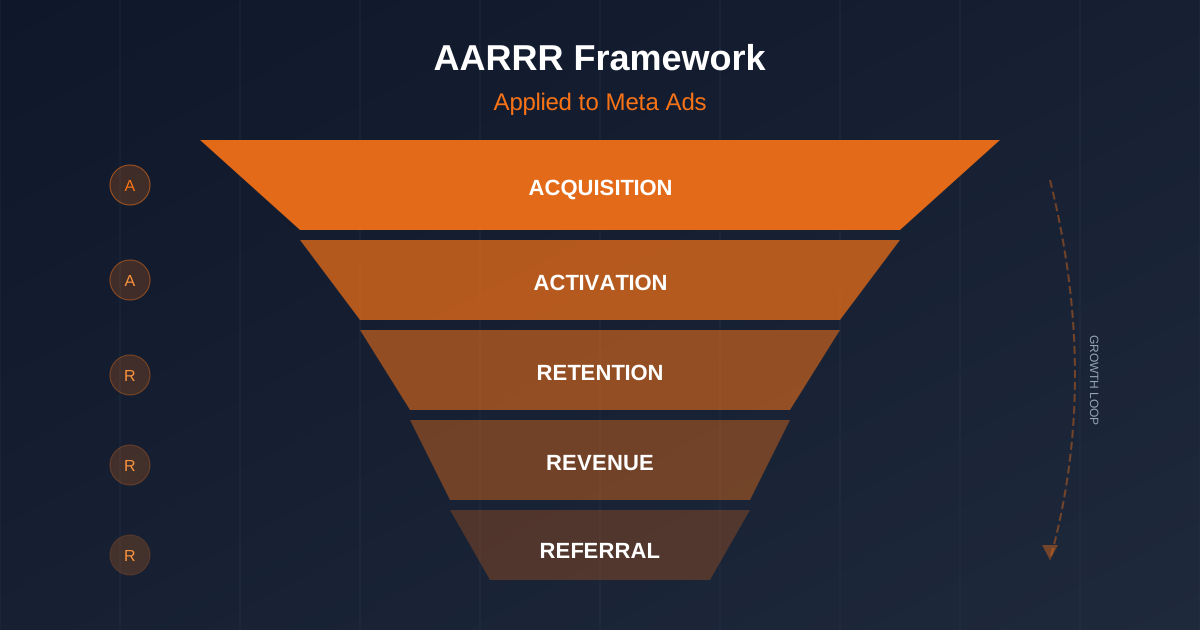
AARRR stands for Acquisition, Activation, Retention, Revenue, and Referral. These five stages represent the complete customer lifecycle from first touch to advocacy. Each stage has distinct goals, metrics, and strategies. The framework is sometimes called pirate metrics because of how the acronym sounds when spoken aloud.
For Meta Ads specifically, AARRR provides a lens to evaluate whether your campaigns are serving all five stages or whether you are over-investing in one area while neglecting others. Many advertisers pour budget into acquisition while completely ignoring retention and referral, leaving enormous value on the table. A balanced AARRR Meta Ads approach ensures full-funnel coverage.
The beauty of this framework is its simplicity. Each stage answers one question: Acquisition asks how users find you, Activation asks whether they have a great first experience, Retention asks whether they come back, Revenue asks whether they pay, and Referral asks whether they tell others. When you map these questions to Meta campaign objectives, a clear strategy emerges.
Acquisition: Filling the Top of the Funnel with Meta Ads
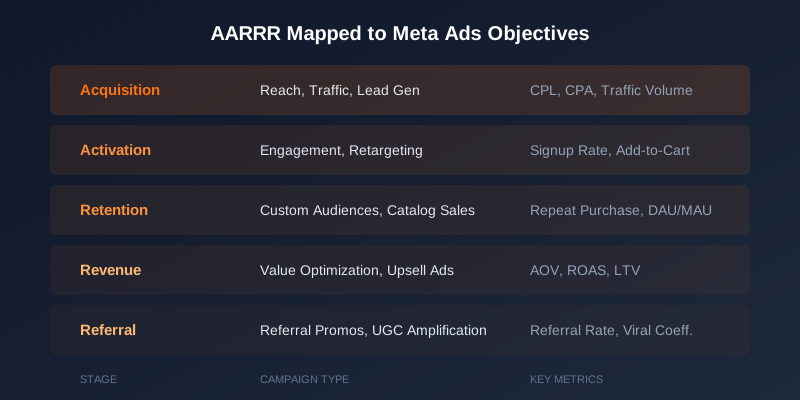
Acquisition is where most advertisers start and where Meta Ads excels. The goal here is simple: bring new people into your ecosystem. This typically means driving traffic to your website, generating app installs, or capturing leads. Meta's broad targeting, lookalike audiences, and Advantage+ campaigns are all acquisition tools.
The key metric at the acquisition stage is cost per acquisition (CPA) or cost per lead (CPL), but raw volume matters too. You need enough new users entering the funnel to make the subsequent stages viable. If your acquisition campaigns are generating fifty leads per month, even perfect activation and retention rates will not produce meaningful revenue.
For AARRR Meta Ads strategies at the acquisition level, focus on awareness and reach campaigns for cold audiences, traffic campaigns to drive site visits, and lead generation campaigns to capture contact information. Test multiple creative angles to find what resonates with different audience segments. Track not just cost per result but also the quality of acquired users by monitoring what happens after they enter your funnel.
Activation: Turning Visitors into Engaged Users
Activation is the most overlooked stage in the AARRR framework, yet it has the highest leverage for improving overall funnel performance. Activation measures whether a newly acquired user experiences the core value of your product or service. For a SaaS product, activation might mean completing onboarding. For an e-commerce store, it might mean adding an item to cart or creating an account.
Meta Ads can directly improve activation rates through retargeting campaigns aimed at users who visited but did not complete a key action. If someone downloaded your app but never opened it, a well-timed engagement campaign can drive them back. If someone browsed your product catalog but did not add anything to cart, a dynamic product ad showing relevant items can trigger that first meaningful interaction.
The activation stage is where your AARRR Meta Ads strategy needs the tightest integration between advertising and product experience. Your ads set expectations, and your landing page or app must deliver on them immediately. A disconnect between ad promise and product reality kills activation rates regardless of how much budget you invest.
Retention: Keeping Customers Coming Back Through Paid Media
Retention is where growth compounds. Acquiring a customer once is expensive; getting them to return is where profitability lives. Meta Ads plays a critical role in retention through engagement campaigns, custom audience targeting of existing customers, and sequential messaging that keeps your brand present in their daily scroll.
Stop wasting ad budget
NovaStorm AI cuts Meta Ads CPA by 30% on average. No complex setup required.
Build custom audiences of customers segmented by purchase recency and frequency. Target lapsed customers with re-engagement campaigns before they churn completely. Use catalog sales campaigns to show existing customers new products or complementary items. Create content-focused campaigns that provide value without asking for a purchase, building habitual engagement with your brand.
Retention campaigns often have the lowest cost per result in your entire AARRR Meta Ads strategy because you are reaching people who already know and trust your brand. The warm audience means higher relevance scores, lower CPMs, and better conversion rates. Yet many advertisers allocate less than five percent of their budget to retention, missing an enormous efficiency opportunity.
Revenue: Optimizing Campaigns for Monetary Value
Revenue in the AARRR framework is not just about generating sales. It is about maximizing the monetary value of each customer interaction. This means optimizing for average order value, purchase frequency, and customer lifetime value rather than just conversion count.
On Meta, revenue optimization involves using value-based lookalike audiences built from your highest-value customers, implementing value optimization in your conversion campaigns, and testing upsell and cross-sell campaigns to existing buyers. Dynamic product ads that feature bundles or complementary products can increase average order value without requiring additional acquisition spend.
Track your revenue metrics carefully. Cost per acquisition is meaningless without understanding the revenue that acquisition generates. A campaign with a forty dollar CPA is excellent if the average customer spends two hundred dollars, but terrible if they spend fifty. AARRR Meta Ads frameworks demand that you connect ad spend to revenue outcomes, not just conversion events.
Referral: Turning Customers into Advocates via Paid Social
Referral is the final stage of AARRR and the one that creates exponential growth. When customers actively recommend your product to others, your effective acquisition cost drops dramatically. Meta Ads can accelerate referral behavior in several ways.
Promote referral programs directly to your existing customer base through targeted campaigns. Use testimonial and user-generated content in your ads to demonstrate social proof, which encourages others to share their own experiences. Create shareable content that customers want to pass along organically, then amplify its reach with paid distribution.
The referral stage also feeds back into acquisition. Referred customers typically have higher lifetime values and lower churn rates than those acquired through cold advertising. By measuring referral as part of your AARRR Meta Ads strategy, you can identify which acquisition sources produce the most referral-prone customers and allocate budget accordingly.

Measuring Full-Funnel Health and Running Growth Experiments
The real power of AARRR Meta Ads comes from measuring all five stages simultaneously and identifying your weakest link. Your growth rate is constrained by your worst-performing stage. If acquisition is strong but activation is poor, adding more acquisition budget is wasteful. If retention is excellent but referral is nonexistent, you are missing free growth.
Build a dashboard that tracks conversion rates between each AARRR stage. Calculate the drop-off between acquisition and activation, activation and retention, retention and revenue, and revenue and referral. The largest drop-off is your highest-leverage improvement opportunity. Focus your experimentation resources there.
Growth experimentation follows a simple cycle: identify the bottleneck stage, form a hypothesis about what would improve it, design an experiment using Meta Ads or landing page changes, run the test with statistical rigor, and either implement the winner or learn from the failure. Running two to three experiments per week across different AARRR stages creates a continuous improvement engine that compounds over months and quarters.
The AARRR framework transforms Meta Ads from a series of disconnected campaigns into a unified growth system. By mapping every campaign to a specific stage, measuring conversion between stages, and systematically experimenting to remove bottlenecks, you build an advertising operation that gets more efficient over time rather than hitting diminishing returns. Start by auditing your current campaigns against the five stages, identify where you are under-investing, and redirect budget to fill the gaps.
Novastorm AI automates Meta Ads routine — from monitoring to optimization. Learn more at novastorm.ai
Disclaimer: This article was generated with the assistance of AI and reviewed by the NovaStorm AI team. While we strive for accuracy, we recommend verifying specific data points and consulting official sources (linked where available) for critical business decisions.
Ready to automate your Meta Ads?
NovaStorm AI takes full responsibility for your campaigns — from monitoring to optimization.
Start NowRelated Articles

AI Funnel Fingerprint Analysis for Meta Ads
Use AI-powered Meta Ads analytics to find funnel drop-offs and automate journey-specific creative for better conversions.

AI-Powered Meta Ads Lead Qualification for Sales
Learn how AI-powered Meta Ads lead qualification and conversation intelligence speed up sales handoff and improve lead quality.

AI Workflows for Cross-Platform Ad Repurposing
Learn how AI-powered Meta Ads creative adapter workflows improve creative repurposing, consistency, and performance across platforms.