

Freelance Media Buying: How to Run a One-Person Meta Ads Business
Price a solo Meta Ads service from actual capacity and costs, define a revenue bonus precisely and make client approval part of delivery.
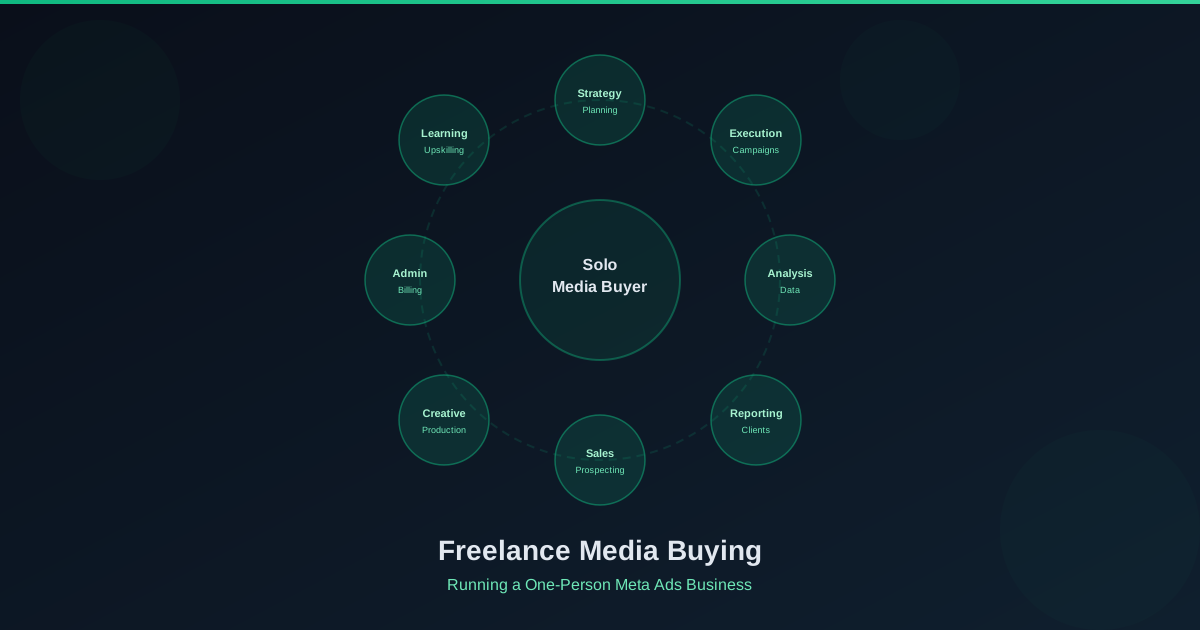
A one-person media buying business needs a sustainable workload and a clear service offer. Revenue promises do not establish profit, and percentage fees can create an incentive to increase client spend. Start with a time log, cost sheet and explicit scope.
Work the $2,000 plus 5% model
This is a fictional commercial proposal, not a market rate, client contract or legal template. Have the actual agreement reviewed for your business and jurisdiction. The example uses a $2,000 monthly base and a 5% bonus on eligible retained revenue above $30,000.
| Monthly work | Assumed hours / cost | Allocation |
|---|---|---|
| Campaign preparation and monitoring | 16 hours at $40 = $640 | Owner labor |
| Creative briefs and review | 8 hours at $40 = $320 | Owner labor |
| Reconciliation and client reporting | 8 hours at $40 = $320 | Owner labor |
| Communication and approvals | 6 hours at $40 = $240 | Owner labor |
| Contracted approved creative production | 300 | Direct expense |
| Allocated tools | 100 | Direct expense |
| Total service cost | 1,920 | 38 owner hours × $40 + $400 expenses |
If eligible retained revenue is $38,000, bonus = 5% × max($38,000 − $30,000, 0) = $400. Fee is $2,400; $2,400 − $1,920 leaves $480 before other overhead and tax. With no bonus, only $80 remains. Increasing the assumed work to 50 hours would cost $2,400 including the same expenses, leaving no margin even with this bonus. Replace the assumptions with recorded time, contractor invoices and actual overhead.
Define eligible revenue from unique paid orders after the agreed refund/chargeback window, excluding taxes and other stated pass-through amounts. Specify currency, source-credit rule, threshold, exclusions, later-refund adjustment and approval date in the agreement. Two platforms crediting one order must not generate two bonus payments. A reporting allocation is not proof that the freelancer caused that revenue.
A ready-to-adapt service proposal
- Scope: one named account, one market and one approved offer; monthly campaign drafts, two creative briefs, declared monitoring coverage and one monthly reconciliation report. Extra markets, shoots or landing development require a separately accepted scope.
- Client responsibilities: supply truthful product details, rights-cleared assets, authorized account access and settled order/refund data; approve budget and material before release.
- Working arrangement: named owner, agreed response hours, incident contact and backup plan. Clarify that routine reporting response time does not imply continuous overnight coverage.
- Commercial terms: $2,000 base plus the explicitly defined bonus in this fictional example; delivered media spend and approved contractor extras are separate. No guarantee of revenue, profit or a specific CPA.
- Decision boundary: freelancer prepares and checks; client authorizes exposure and release. Define incident/loss-limit authority and access removal at exit with the responsible owner.
Stop wasting ad budget
NovaStorm AI cuts Meta Ads CPA by 30% on average. No complex setup required.
A three-part monthly report
| Section | Illustrative entry | Limit or decision |
|---|---|---|
| 1: summary | Media spend $1,000; 40 unique retained new buyers; media-only CAC $25 | Synthetic teaching row; include maturity and cost scope |
| 2: reconciliation | Two duplicate event rows excluded; three pending refunds listed separately | Keep unknown outcomes and source allocation visible |
| 3: next actions | Prepare one offer-panel test with an agreed cap and review date | Client approves the experiment and any further exposure |
This report example is not an observed client account. Explain confirmed defects and uncertain hypotheses separately; do not invent a causal explanation for every metric change. Reports need checking and correction time, so track those hours too.
Calculate capacity before accepting another client
If a fictional month offers 120 work hours, with 30 reserved for business development, administration and leave, 90 remain for client delivery. At 38 hours per client, two clients use 76 hours and three require 114. The third does not fit the stated capacity unless scope, staffing or hours change. This arithmetic replaces an unsupported monthly-income promise.
A proposed NovaStorm workflow is to prepare approved Meta material as paused campaign and local ad-set drafts, send the specific version for client approval and release only within the accepted plan. Measure time before and after on comparable tasks before claiming a saving; tools do not remove rights, finance or client review. Use the approval workflow and service-pricing guide to keep scope and price connected.
Published by NovaStorm AI. Planning examples are illustrative assumptions, not measured customer results.
Disclaimer: This article was generated with the assistance of AI and reviewed by the NovaStorm AI team. While we strive for accuracy, we recommend verifying specific data points and consulting official sources (linked where available) for critical business decisions.
Ready to automate your Meta Ads?
NovaStorm AI takes full responsibility for your campaigns — from monitoring to optimization.
Start NowMore on Agency operations and careers
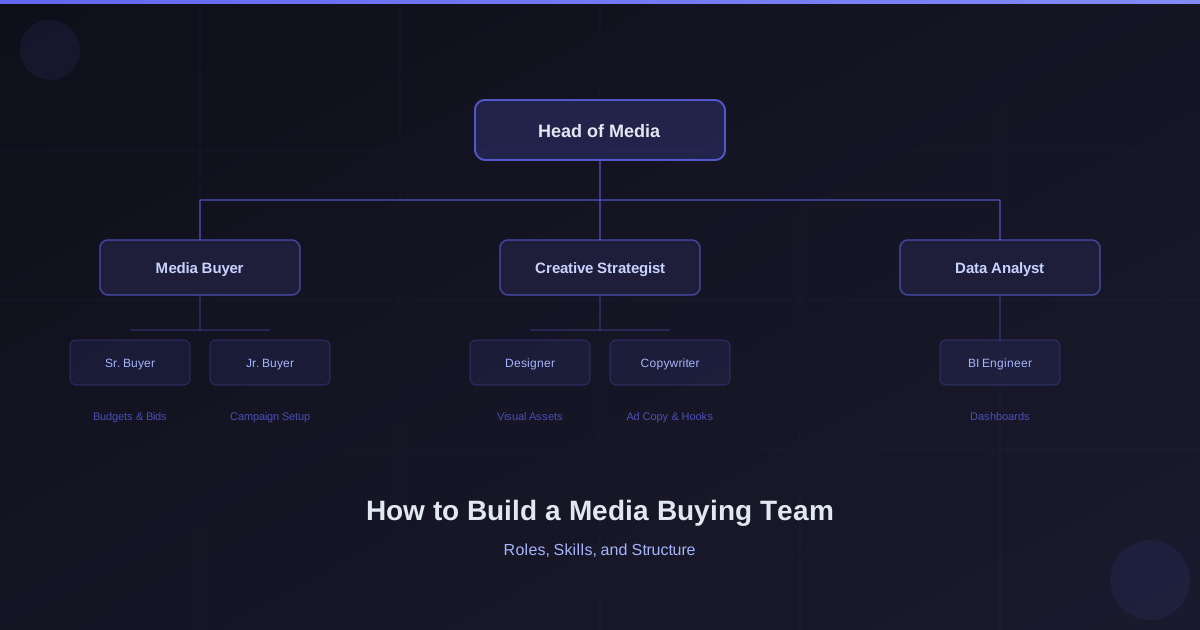
How to Build a Media Buying Team: Roles, Skills, and Structure
Size a media buying team from workload and hiring cost, define approval responsibilities and train new buyers before granting live budget authority.

Agency Operations for Meta Ads: Systems and Processes at Scale
Use owned onboarding and launch forms, verify event delivery and access removal, and reconcile agency capacity and reports before approving client work.
Managing Multiple Ad Accounts: Agency Best Practices
Onboard client accounts with verified asset IDs and task permissions, review templates safely, and end access with an auditable handoff.
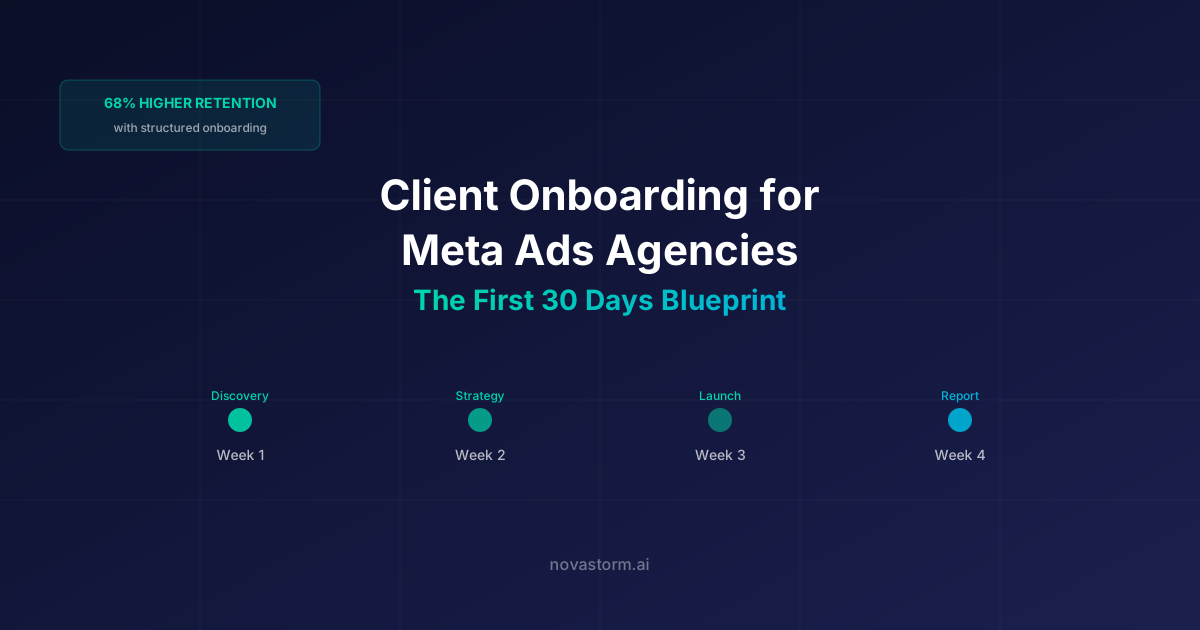
Client Onboarding for Meta Ads Agencies: First 30 Days
Onboard Meta clients with filled discovery, task-based access and expectations documents, launching only after events and approvals are ready.