

Food and Restaurant Ads on Meta: Plan Dine-In and Delivery Campaigns
Plan separate restaurant dine-in and delivery campaigns with verified local eligibility, complete mobile booking or payment paths and contribution-based cost limits.

A restaurant ad should lead to an action the venue can fulfill: a completed booking, an attended visit or a paid delivery order. These outcomes have different margins, capacity limits and measurement paths. Separate them in the brief before choosing creative, geography or a campaign goal.
Verify the current objective and service area
Meta’s current campaign SDK lists outcome objectives including Awareness, Engagement, Leads, Sales, Traffic and App Promotion. It does not establish a universally available standalone Store Visits or Local Awareness objective. Check the actual account’s destination, performance goals and any location/visit measurement eligibility before relying on them.
Choose geography from aggregated customer origins, travel feasibility and the actual delivery boundary. A radius is a planning proxy, not a guarantee that everyone in it can order or will visit. Record the controls the account provides, their current location interpretation and any limits. Do not assume automatic radius changes by meal time.
For a dine-in pilot, map the neighborhoods of prior consenting customers or bookings in aggregate without exposing individual addresses. For delivery, check postcodes and operational route boundaries against the ordering system. A fixed one-to-three or fifteen-to-twenty-mile rule is not evidence about your restaurant’s trade area.
Dine-in: booking and attended-service economics
| Step | Acceptance check |
|---|---|
| Ad | Actual dish, price conditions, location, dates and available service hours. |
| Mobile reservation page | Correct branch, readable menu, accessible date/time and party-size selection. |
| Confirmation | Booking ID, correct slot, venue address, cancellation terms and actual confirmation delivery. |
| Venue record | Attended/no-show status and reconciled bill, without counting a reservation as a completed visit. |
Hypothetical contribution: a two-person booking yields $60 revenue excluding tax, minus $24 food cost and $16 variable service/payment cost, leaving $20 before acquisition. With a $5 required reserve, allowable acquisition cost per attended booking is $15. If a measured cohort later shows 75% of bookings attend, the corresponding expected allowance per booked reservation is $11.25 before any other acquisition cost. The attendance rate here is an assumption, not venue data.
Use accurate dish photography or licensed customer footage. Candidate copy: “See the menu and reserve a table.” An illustrative weekend promotion needs confirmed hours and capacity; do not imply an unverified event partnership or guarantee tables will fill.
Stop wasting ad budget
NovaStorm AI cuts Meta Ads CPA by 30% on average. No complex setup required.
Delivery: payment and order contribution
| Step | Acceptance check |
|---|---|
| Ad | Actual menu item, verified delivery availability and full promotional conditions. |
| Ordering destination | Correct branch/item; postcode eligibility; stock and required options. |
| Checkout | Visible delivery fee, minimum order, total price and permitted test-mode payment. |
| Confirmation/fulfillment | Unique paid order, accepted delivery request and cancellation/refund status. |
Hypothetical delivery order: $30 net revenue minus $11 food cost, $5 platform commission, $4 packaging/delivery subsidy and $1 expected refund allowance leaves $9 before acquisition. Keeping a $3 reserve permits $6 total acquisition cost. Production cost and discounts reduce the media allowance further. Do not apply the dine-in booking cap to delivery orders.
A third-party delivery destination may not expose tracking or accept your Pixel. Confirm the partner’s available reporting and integration rights; no route guarantees complete conversion data. Reconcile orders using available identifiers and aggregate reports rather than treating link clicks as paid deliveries.
Promo-code matching does not establish additional revenue
A code can help match recorded transactions to a promotion, but some redeemers might have ordered anyway. Code sharing, missing entry and cross-device use also limit attribution. Report code-associated orders separately from incremental orders.
- Choose one outcome per pilot and declare the maximum cash-loss limit, conversion/maturation interval and operational capacity.
- For incrementality, use an eligible holdout or a carefully designed matched-area/time comparison with a clear baseline. Account for weather, events, opening hours, existing demand and contamination.
- Compare mature contribution and total acquisition cost across prospecting and follow-up, deduplicating orders. Do not call an observational promo-code report causal lift.
- Stop on a failed booking/payment path, stock or capacity failure, or the agreed loss limit. Keep low-volume results inconclusive rather than declaring a winning format from CTR.
Use the local campaign guide and creative framework for the brief. NovaStorm can support proposed creative and paused campaign/local ad-set draft preparation for review; it does not establish visit tracking, delivery integration or automatic geographic scheduling.
Published by NovaStorm AI. Planning examples are illustrative assumptions, not measured customer results.
Disclaimer: This article was generated with the assistance of AI and reviewed by the NovaStorm AI team. While we strive for accuracy, we recommend verifying specific data points and consulting official sources (linked where available) for critical business decisions.
Ready to automate your Meta Ads?
NovaStorm AI takes full responsibility for your campaigns — from monitoring to optimization.
Start NowMore on Local business advertising
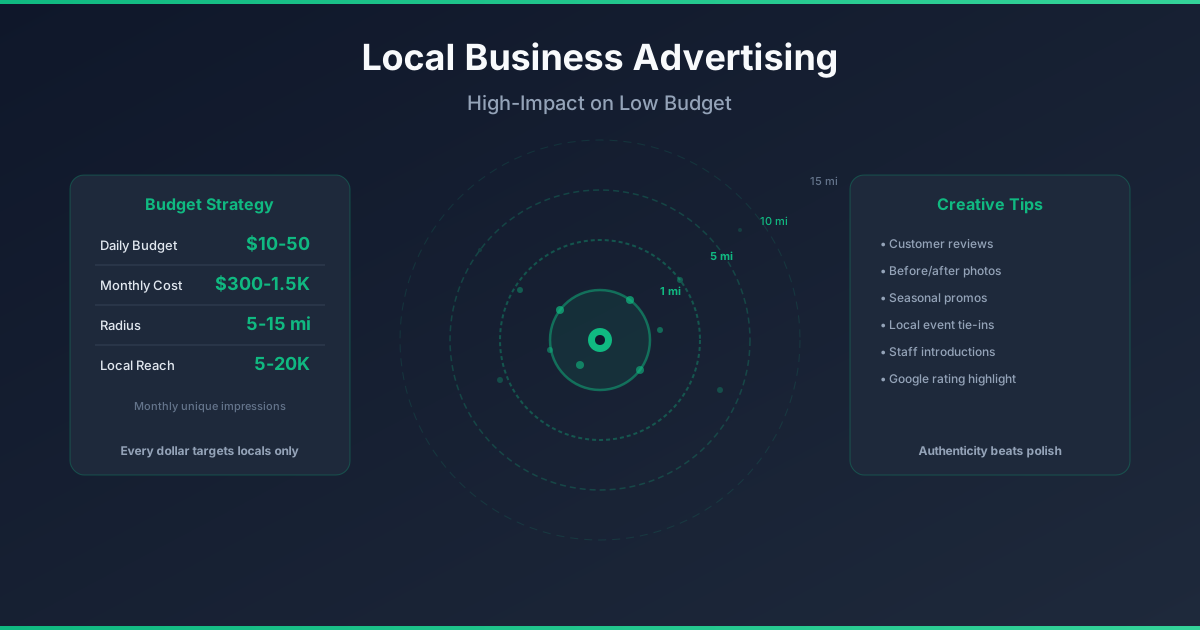
Local Business Advertising on Meta: Coverage and Small-Budget Plan
Prepare a local Meta brief from actual service coverage, booking economics and approved creative, then evaluate mature appointments within a small budget.

Meta Ads for Real Estate: Property Listing and Lead Strategies
Prepare truthful property and valuation ads, check market-specific Housing restrictions, and budget against collected commission rather than lead volume.

Automotive Ads on Meta: Inventory and Sales Measurement
Validate vehicle inventory and finance disclosures, select an eligible objective and real event, and reconcile leads with visits and settled dealership sales.

Travel and Hospitality Ads on Meta: Booking Funnel Checks
Match travel creative to bookable dates and total price, verify catalog and attribution settings, and judge retained bookings after cancellations and commission.