

Fintech App Advertising on Meta: Banking and Payment Campaigns
Plan fintech app ads with country-specific promotion approval, minimal event data and fraud-adjusted customer economics.
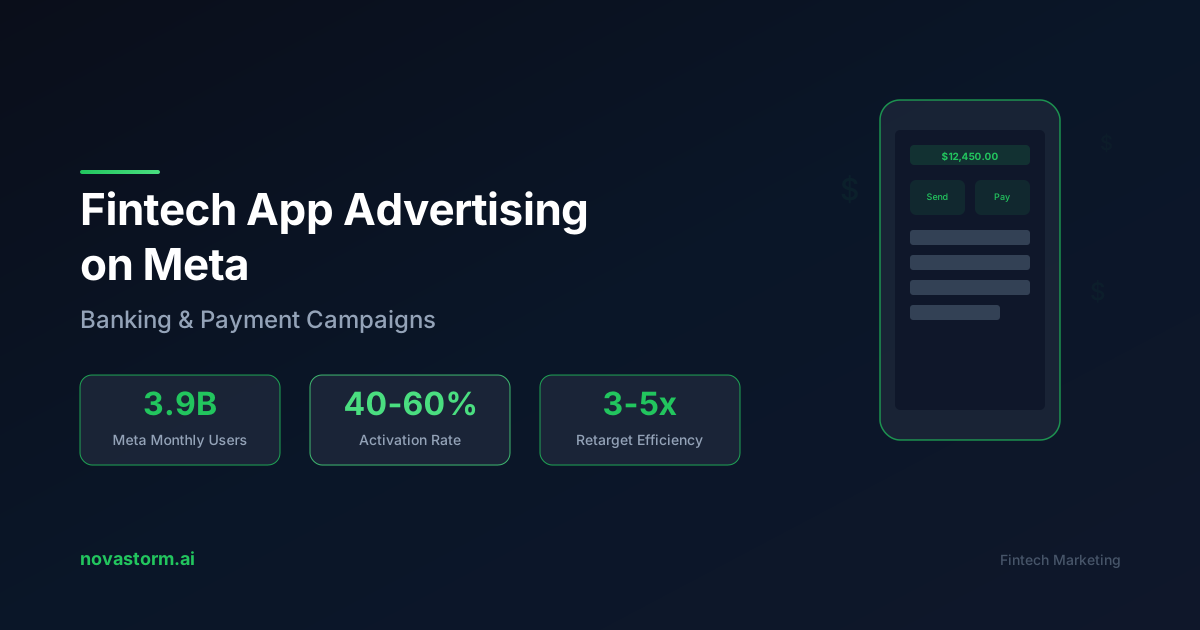
A banking or payment-app campaign needs a product-and-country approval record before creative testing. An app install is not a qualified customer, completed identity verification is not a profitable payment, and a customer balance is not revenue. Plan acquisition against permitted measurement and mature unit economics.
Authorization depends on product and jurisdiction
For a UK example, the FCA’s social-media financial-promotion guidance applies the financial-promotion rules to social channels and discusses approval by appropriately authorized persons. Identify whether the exact banking, payment, credit, investment or crypto communication falls within the applicable regime. Do not transfer one product’s approval to another country or entity.
Review Meta’s financial-products category guidance in the actual account. Record advertiser country, target countries, legal entity, product, required verification, category designation, available targeting and approving expert. Special-category designation and advertiser authorization are different checks. Keep the draft paused until both are resolved; do not promise approval in a fixed number of days or universal lookalike availability.
A minimum-data event boundary
| Internal data | Advertising boundary |
|---|---|
| KYC passport, selfie or document result | Do not send documents or detailed verification results |
| Bank/account/card identifiers | Do not send account numbers or credentials |
| Balance, deposit, credit history or transaction narrative | Keep financial details outside advertising payloads |
| Permitted nonsensitive milestone | Use only after terms, consent and account restrictions permit its meaning and fields |
| Value optimization | Verify current eligible event, permitted value and account eligibility; no readiness guarantee from fifty events |
Check Meta’s Business Tools Terms with the privacy owner for the actual event and source. Hashing does not turn a prohibited financial disclosure into acceptable data. Inspect URLs, event names and custom fields as well as identity fields. If a compliant event path cannot be established, use a reviewed earlier nonsensitive measurement approach rather than uploading KYC or payment records.
Define a qualified activation in the internal ledger
Stop wasting ad budget
NovaStorm AI cuts Meta Ads CPA by 30% on average. No complex setup required.
Illustrative payment-app definition: an eligible unique customer completes the product’s required onboarding and performs a legitimate settled transaction that is not reversed, fraudulent or a self-transfer incentive exploit under the product rules. This internal definition must not be assumed to be shareable with Meta. Record verified identity status only in the secured system that needs it.
Synthetic equal-age cohort: USD 1,000 advertising spend, 100 installs, 20 nominal first transactions and five later invalidated for fraud or reversal. Fifteen qualified customers remain; cost per qualified customer is 1,000 / 15 ≈ USD 66.67. Suppose their aggregate service revenue is USD 150, payment costs USD 45, support USD 30 and fraud losses USD 20: contribution before advertising is USD 55, and after advertising USD −945. Customer deposits are not included as revenue.
These assumptions show why low install cost is insufficient. Track matured retention, chargebacks, referral/incentive costs and permitted support costs before estimating payback. Keep unresolved fraud cases pending. No fixed lifetime-value ratio or calendar progression to value optimization is assumed.
A reviewed creative brief
Illustrative draft direction for a permitted payment product: “Review transfer fees and supported destinations before choosing a plan.” Use the actual fee schedule, service availability and material limitations. Demonstrate with fictional accounts and test data; no security badge, deposit-protection claim or onboarding-time promise without evidence and expert approval.
- Have a qualified legal/compliance owner approve the exact ad, destination, disclosures, product entity and geographic availability.
- Have the privacy owner approve audience sources and event payloads independently. Retargeting based on incomplete KYC or financial status is not assumed permitted.
- Choose a spending ceiling and mature outcome window; include inconclusive results and stop conditions for complaints, fraud or unavailable service.
- Prepare the approved message as a NovaStorm campaign draft and review it before publication. Legal review, sensitive-event handling and fraud assessment remain expert and product-team responsibilities.
Published by NovaStorm AI. Worked examples and test fixtures in this article are illustrative, not observed customer results.
Disclaimer: This article was generated with the assistance of AI and reviewed by the NovaStorm AI team. While we strive for accuracy, we recommend verifying specific data points and consulting official sources (linked where available) for critical business decisions.
Ready to automate your Meta Ads?
NovaStorm AI takes full responsibility for your campaigns — from monitoring to optimization.
Start NowMore on SaaS and app growth
AI and Machine Learning Product Ads on Meta: Tech Marketing
Substantiate AI product ads with task-specific evaluation, reproducible conditions and separate technical and business claims.
Advantage+ App Campaigns on Meta: Automated App Install Strategy
Evaluate Advantage+ app campaigns with SDK and ATT readiness checks, meaningful creative questions and mature-cohort unit economics.
Developer Tool Ads on Meta: Reaching Technical Audiences
Build developer-tool ads from safe CLI demonstrations, permissioned activation definitions and paid-adoption evidence.
Viral Loop Campaigns on Meta: Designing Ads That Get Shared
Define referral generations, deduplicate new customers and include incentive cost. Evaluate useful sharing without confusing organic impressions with sales.