

E-commerce Product Photography for Meta Ads: Plan and Test Visual Styles
Plan product-only, contextual and detail photos with accuracy and rights checks, then compare mature customer economics including production cost.
Product photography should help a buyer identify the actual item and assess its use. Whether a contextual image outperforms a clean product photo is a hypothesis for your offer and audience. It is not a universal conversion rule, and a misleading image is not acceptable merely because it attracts clicks.
One proposed three-photo set
The following is a proposed shoot for one backpack, not a photographed or tested set. No real product images or customer UGC rights have been supplied. Use the same actual SKU in all three shots and keep a reference photograph, product specification and accepted color sample with the brief.
| Planned image | Shot brief | Accuracy acceptance gate |
|---|---|---|
| Product-only | Front and three-quarter view on a simple neutral background, with enough separation to identify the straps and opening. | Actual color, dimensions, logo, number of compartments and included accessories match the sold SKU. |
| Contextual | The same backpack worn by a permitted model on an appropriate everyday route. | Scale and fit are accurate; no invented waterproofing, hiking capacity or load claim is implied by the scene. |
| Detail | Close-up of the same item’s zipper, seam or fabric beside a full-product reference. | Texture and hardware match the actual item; the close-up does not imply a material or durability certification absent from evidence. |
This brief supplies production decisions, not substitute evidence of a shoot. If real photos become available, record their asset IDs, capture date, rights and approved product revision. Keep a customer-originated image labeled UGC only when it actually came from a customer and permission covers the intended paid use.
Clear rights before editing or publishing
- Record photographer ownership/license and the scope of paid advertising permission, including platforms, territories, term and allowed edits.
- For customer footage or photos, obtain the applicable permission; credit, tagging or public availability alone is not a paid-media license. Review people, locations and recognizable third-party marks.
- Keep original and edited versions together. Confirm any recolor, background replacement or generated scene does not invent product geometry, accessories, scale or use conditions.
- If incentives or endorsements are involved, assess the relevant disclosure requirements. Never turn an actor or synthetic person into a supposed customer testimonial.
Choose composition by readability, not fixed percentages
Preview the accepted image at the actual selected placement and phone size. Can a reviewer recognize the product and understand the offer without zooming? Check crop, interface overlays, detail visibility and text contrast. Adjust product scale to that inspection rather than requiring it occupy 60–70% of every frame.
Stop wasting ad budget
NovaStorm AI cuts Meta Ads CPA by 30% on average. No complex setup required.
Use actual delivery reports to assess device mix. No unverified 90% mobile-share statistic is needed to justify testing a mobile preview. Allocate photography effort by measured contribution, stock and evidence gaps; an 80/20 distribution is a hypothesis until your catalog data demonstrate it.
A clean product image may clarify shape or variant; context may explain a useful task; a detail image may answer a quality question. Choose what a buyer needs to know, and avoid assuming any background color or photo origin guarantees better sales.
Compare business value after production costs
Hypothetical budget: product-only preparation costs $60 and contextual preparation costs $180. A pilot spends another $200 on each. If the product-only variant yields ten mature retained orders and the contextual variant yields twelve, media CPA is $20 versus about $16.67. Including allocated production, acquisition cost is $26 versus about $31.67. The apparent media advantage reverses once these assumed production costs are included. This is teaching arithmetic, not an observed result.
Define how reusable production cost is allocated before comparing variants. A longer reuse horizon may change the calculation, but future orders are a forecast. Do not omit production cost from one arm while charging it to another.
- State the hypothesis and outcome, such as retained orders at an acceptable contribution after acquisition. Keep SKU, offer, destination and measurement rules consistent.
- Use an eligible controlled experiment when causal evidence matters; ordinary adaptive delivery or separate calendar periods are observational.
- Set a media cash-loss limit plus the production budget before launch. Define purchase/refund maturation from your business cycle and inspect measurement failures.
- Record spend, actual delivery, deduplicated orders, returns, contribution and production cost. Seven days or 1,000 impressions is not a universal reliable sample.
- Choose a variant only after the declared economic and accuracy gates pass. If outcomes are sparse, retain the baseline and call the result inconclusive.
Use the product-versus-lifestyle guide and creative framework for the log. NovaStorm can support proposed variant and paused campaign/local ad-set draft preparation for human review. Product truth, licensed originals and brand approval require separate verification; no actual shoot or built-in UGC rights clearance is demonstrated here.
Published by NovaStorm AI. Planning examples are illustrative assumptions, not measured customer results.
Disclaimer: This article was generated with the assistance of AI and reviewed by the NovaStorm AI team. While we strive for accuracy, we recommend verifying specific data points and consulting official sources (linked where available) for critical business decisions.
Ready to automate your Meta Ads?
NovaStorm AI takes full responsibility for your campaigns — from monitoring to optimization.
Start NowMore on Visual creative and design
Thumb-Stop Rate: Calculate Attention and Check Acquisition Cost
Calculate thumb-stop rate with a consistent impression denominator and evaluate openings against mature acquisition cost, not attention alone.
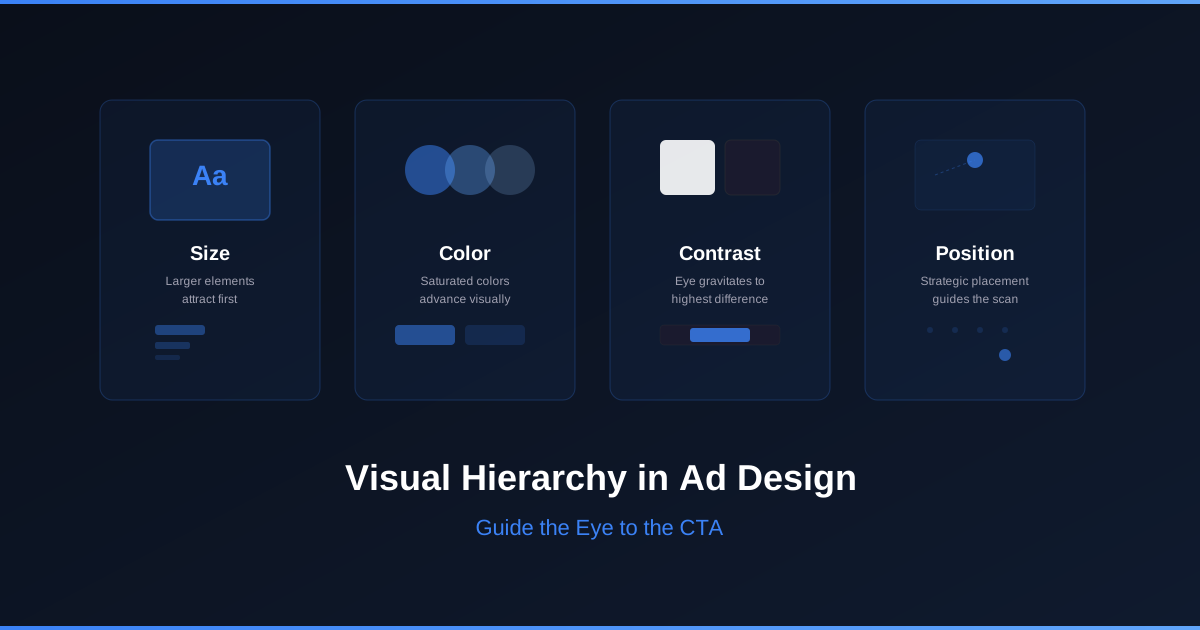
Visual Hierarchy in Ad Design: Guide the Eye to the CTA
Specify a readable ad layout at its displayed mobile scale, measure text contrast and test one hierarchy change against mature acquisition cost.

The Psychology of Color in Meta Ad Creative
Choose a readable Meta ad palette, distinguish drawn labels from native controls, and test one color parameter against mature paid outcomes.

Advantage+ Creative Enhancements: What Meta Auto-Changes and When to Opt Out
Review the creative enhancements actually available in your account, preserve the approved source and test brand-safe settings against mature outcomes.