

Collaborative Ads on Meta: Brand and Retailer Partnership Campaigns
Prepare a brand–retailer campaign agreement, validate shared-product access and reconcile reporting before funding collaborative advertising.
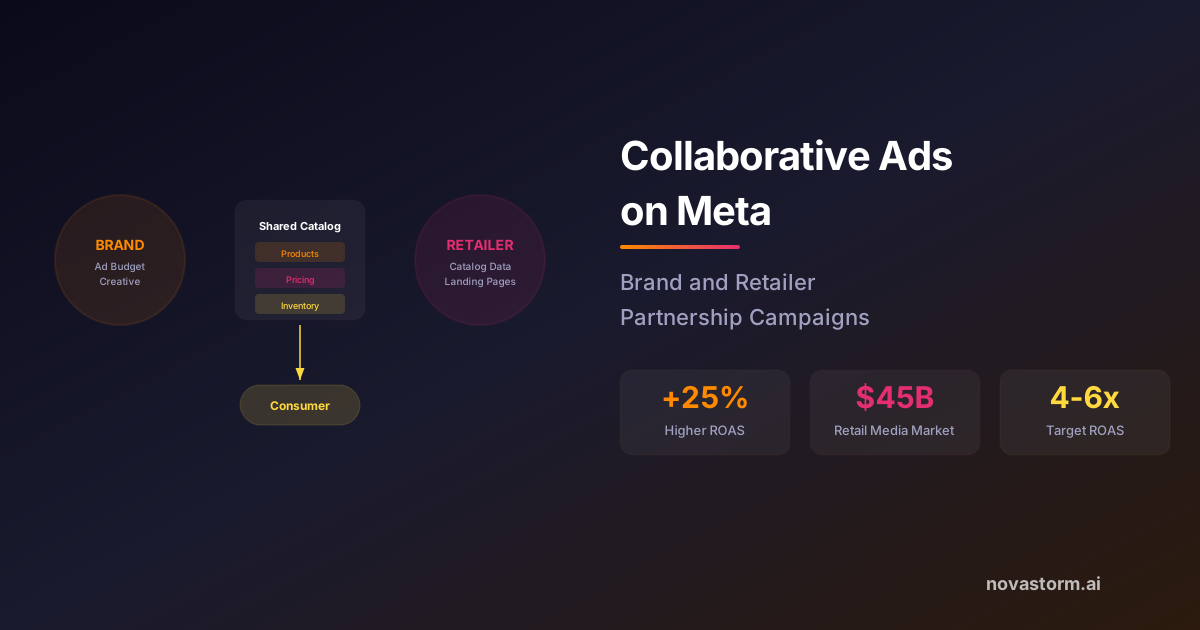
A brand–retailer campaign requires an explicit agreement about catalog access, destination ownership, measurement and costs. A named retailer or a historical format tutorial does not establish that a current collaborative-ads partnership is available. Verify actual partner eligibility and supported configuration before commissioning creative or sharing business assets.
Accept the partner contract before the ad
The partner and account owners must retain the current contract or in-account evidence for the shared catalog segment, granted permissions and eligible campaign settings. Use this acceptance worksheet before launch, rather than prescribing an objective from a historical tutorial.
| Contract item | Brand responsibility | Retailer responsibility |
|---|---|---|
| Authorized catalog segment | Confirm only approved products are usable | Document segment owner and grant/revocation process |
| Product/destination | Approve representation and offer | Verify current price, stock and purchasable URL |
| Measurement | Declare accessible report fields and attribution scope | Validate event/product identity and permitted sharing |
| Funding | Sign cash limit and invoicing terms | State co-funding and any extra charges |
| Publication | Approve final version and launch authority | Approve brand usage and destination changes |
| Data access | Use only explicitly permitted data | Do not imply raw customer data is automatically shared |
A synthetic partnership release record
Hypothetical agreement: brand B_TEST funds up to USD 600 for SKU_X_TEST in retailer R_TEST’s authorized segment. The brand reviews the current product image and USD 40 price; retailer operations confirms stock and external checkout; measurement owner verifies product identity and test purchase. Launch requires both named owners’ approval. These names and values are synthetic, not a public customer partnership.
- Record the shared segment identifier in the private review, permissions and date; do not expose real business IDs in published copy.
- Preview a permitted product and an excluded product; unauthorized products must not be silently included.
- Check a stock/price update and its propagation to the destination and creative; no instantaneous synchronization is assumed.
- Complete a test purchase and reconcile its product identity; validate whatever reporting fields are actually accessible.
- Record the rollback/revocation owner if access or product availability changes.
Stop wasting ad budget
NovaStorm AI cuts Meta Ads CPA by 30% on average. No complex setup required.
Reconcile two reports without calling them lift
| Hypothetical records | Possible explanation | Resolution |
|---|---|---|
| Platform attributes 12 orders; retailer ledger shows 10 matched paid orders | Window, duplicate, scope or refund mismatch | Align IDs and maturity; retain unresolved difference |
| Retailer total sales rise during promotion | Price, other channels or seasonality changed | Do not assign all growth to the collaborative campaign |
| Brand sees limited shared report | Grant and privacy boundary | Request approved aggregates, not raw customer records |
ROAS = attributed revenue / media spend describes an attribution report. Incremental sales require a credible counterfactual with comparable treatment and control, contamination review and mature returns. Include creative, partner fees and contribution economics in the funding decision. No +25% ROAS, 30–40% lost traffic, 40–60% efficiency improvement or universal 4–6x benchmark is established here.
Bring the approved brief to campaign preparation
The output is a signed partnership brief with one product set, verified destination, actual reporting limits and cash ceiling. Prepare ordinary campaign materials in NovaStorm when compatible with your available configuration, then let the authorized owners approve publication. This article does not promise NovaStorm access to retailer catalogs, partner customer data or collaborative-ads publishing.
Published by NovaStorm AI. Worked examples and test fixtures in this article are illustrative, not observed customer results.
Disclaimer: This article was generated with the assistance of AI and reviewed by the NovaStorm AI team. While we strive for accuracy, we recommend verifying specific data points and consulting official sources (linked where available) for critical business decisions.
Ready to automate your Meta Ads?
NovaStorm AI takes full responsibility for your campaigns — from monitoring to optimization.
Start NowMore on Ad formats and placements
Poll Ads on Meta: Interactive Engagement That Drives Clicks
Validate poll-ad availability and use aggregate votes carefully: separate response bias, rate calculations and commercial message testing.

Meta Ad Creative Field Limits & Crop Specs: Technical QA Workflow
Audit ad creative text limits, enforce punctuation rules, configure placement image crops, and validate preview iframes before publishing on Meta.
Augmented Reality Ads on Meta: Interactive Try-On Campaigns
Evaluate an AR or product-demo destination without relying on obsolete Spark instructions; verify support, camera fallback, unit costs and confirmed outcomes.
Playable Ads on Meta: Interactive Ad Formats for Mobile
Build a faithful playable prototype, verify the actual placement contract, and measure interaction-to-install outcomes with explicit denominators.