

Catalog Sales Optimization: Advanced DPA Strategies for E-commerce
Review catalog data, stock, product contribution and mature orders before changing Meta catalog campaigns or setting a ROAS target.

Catalog Sales Optimization: Advanced DPA Strategies for E-commerce
Optimize a catalog campaign by making the product data truthful, its events traceable and its allowable acquisition cost explicit. Start with the feed and order ledger before changing bids. A dynamic product recommendation is not a guarantee that every advertised SKU or every conversion is profitable.
Accept the feed as a customer-facing record
Use stable product identifiers across the catalog, destination and permitted product events. Check title, image, price, currency, availability and destination for each promoted item. A descriptive name such as “Linen Midi Dress in Sage Green” is useful when it matches the item; it does not justify invented fabric or stock claims. Compare the exact current import contract with Meta’s product-item SDK; account catalog type and accepted feed fields still need validation.
Illustrative merchandising worksheet, not an imported customer feed. Contribution figures are assumed after goods, fulfillment and expected returns, before advertising. Internal margin labels below are planning categories; map them only to fields accepted by the actual catalog import.
| Stable item ID | Customer-facing offer | Stock | Assumed contribution | Internal planning label |
|---|---|---|---|---|
| DRESS-SAGE-M | Linen midi dress, size M, $80 | 12 sellable units | $32 | higher contribution |
| CAMERA-01 | Camera, $300 | 2 sellable units | $45 | limited stock |
| BAG-CAMERA | Camera bag, $40 | 0 sellable units | $18 | unavailable; exclude from active offer |
- Verify each image and mobile link against the actual variant, including price and stock after updates. Do not advertise an unavailable item while assuming the next sync already fixed it.
- Check that permitted ViewContent, AddToCart and Purchase product identifiers refer to the same item identity; a variant mismatch can produce the wrong recommendation.
- Where supported, create a product set for a meaningful merchandising job, then preview the included items. A label or extra image does not guarantee delivery or a CTR increase.
- Record feed refresh time, failed item count, affected set and the owner who fixes a mismatch. Acceptance requires a successful refresh and destination check, not just an upload attempt.
Avoid tiny retargeting windows without an answerable question
A visitor yesterday is not automatically more profitable than one last week. Start with the purchase cycle, permitted audience rules and attainable mature orders. Hypothetical planning case: three recency windows produce only two, one and zero mature orders. Unless they need distinct offers or operational exclusions, merge the windows into one supported audience and preserve recency in the analysis. More ad sets do not create more evidence.
Separate customer acquisition from repeat purchase in the business ledger, even when a platform configuration mixes them. A buyer’s camera purchase can justify a bag hypothesis only when stock, permission and relevance permit it. Do not infer a fixed 60-day repurchase exclusion for every product or promise real-time audience removal.
Stop wasting ad budget
NovaStorm AI cuts Meta Ads CPA by 30% on average. No complex setup required.
A ROAS target is not a product-level profit floor
Meta’s campaign SDK includes bid strategy identifiers, including a minimum-ROAS-style identifier. Its existence does not prove availability for every objective, nor make every order profitable. The ad system sees the values/events supplied; it does not automatically know your returns, contribution or overhead.
Hypothetical portfolio arithmetic: product set A produces $1,000 revenue at an assumed 40% contribution rate after variable costs, while set B produces $1,000 at 15%. Combined revenue is $2,000 and contribution before advertising is $400 + $150 = $550. With $500 advertising and $100 allocated business costs, the calculated result is $550 − $500 − $100 = −$50 even though reported revenue ROAS is 4.0.
For this assumed mix, contribution rate is 27.5%. Before the additional $100 business-cost allocation, break-even revenue ROAS is 1 /0.275 ≈3.64. To cover the extra cost on the same $500 spend, required contribution is $600 and required revenue is $600 /0.275 ≈$2,181.82, giving ROAS about 4.36. Actual product mix and returns can change that threshold. Do not promise portfolio profit from a bid setting.
Allow repeat value only with a cohort and payback plan
Illustrative acquisition allowance: assume a new customer contributes $30 on the first order and $12 from later orders after retention probability, service costs and refunds. Reserve $7 for overhead/risk, giving a chosen ceiling of $35. If later contribution is uncertain, the cash-safe ceiling may instead be $30 −$7 =$23. A low prospecting ROAS cannot be justified simply as 50–70% of retargeting ROAS; verify new-customer identity, repeat contribution and cash timing.
Test presentation and budget changes without benchmark promises
- Change one meaningful presentation hypothesis: an accurate price badge versus the same product without the badge. Keep discounts and return terms identical; review the actual supported preview.
- Predefine unique mature orders, refund-adjusted contribution, a total risk allowance and a decision when results are inconclusive. Cheap clicks cannot prove an overlay improves profit.
- Use an appropriate controlled comparison to assess incremental new-customer acquisition. Retargeting attribution is not evidence that every matched purchase needed an ad.
- Prepare a truthful product offer and capped creative/campaign brief for NovaStorm. Feed management, catalog delivery and exclusion execution need their own verified tools; they are not promised here.
Disclaimer: This article was generated with the assistance of AI and reviewed by the NovaStorm AI team. While we strive for accuracy, we recommend verifying specific data points and consulting official sources (linked where available) for critical business decisions.
Ready to automate your Meta Ads?
NovaStorm AI takes full responsibility for your campaigns — from monitoring to optimization.
Start NowMore on E-commerce catalogs and channels

Dynamic Product Ads Troubleshooting: Fixing Common DPA Issues
Trace a catalog ad issue from feed identity to received product events, record upload history and verify fixes without assuming instant updates.
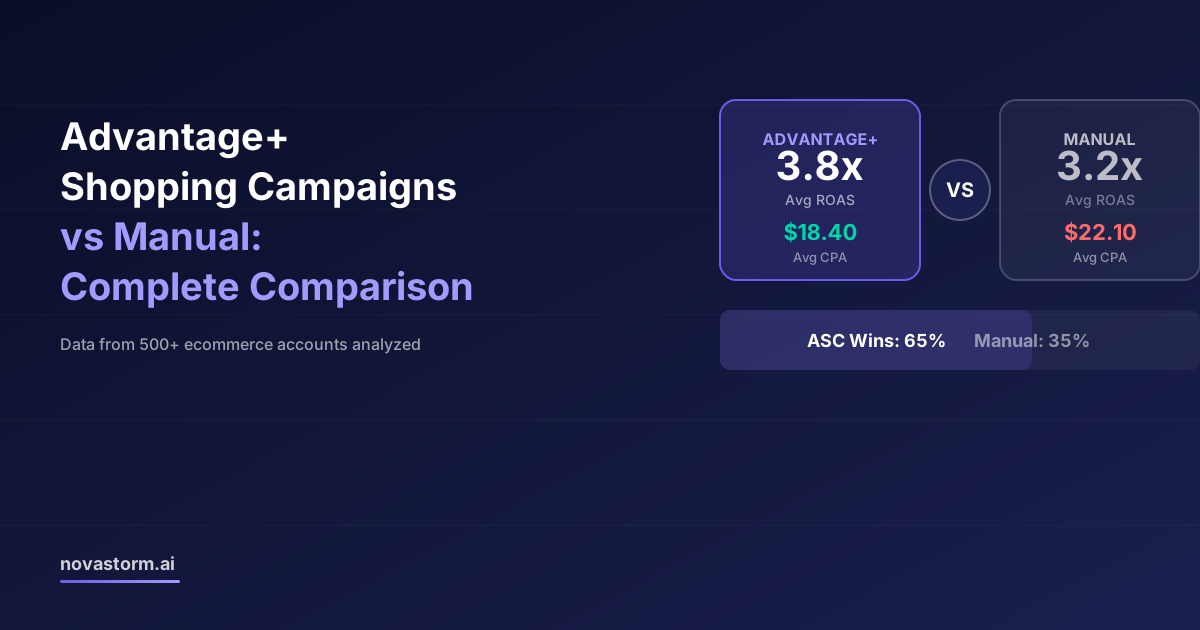
Advantage+ Shopping Campaigns vs Manual: Complete Comparison
Compare actual Advantage+ and manual campaign controls using mature new-customer contribution, saved settings and a capped experiment.

Instagram Shopping Ads: Product Tagging Best Practices
Check Instagram shopping eligibility and the actual checkout route, preview tagged products, and reconcile product IDs through the purchase path.

Product Feed Optimization for Meta Dynamic Ads
Validate a stable-ID product feed, price and stock updates, then isolate title testing on the same products with mature contribution reporting.