Augmented Reality Ads on Meta: Interactive Try-On Campaigns
Master augmented reality ads on Meta with interactive try-on campaigns. Learn AR ad formats, creative best practices, and optimization strategies that drive 33% higher engagement.
The gap between seeing a product online and experiencing it in person has been the central friction point in digital advertising for decades. Augmented reality ads on Meta are closing that gap faster than any other ad format. By enabling users to virtually try on sunglasses, test furniture in their living room, or preview makeup shades on their own face, AR ads transform passive scrollers into active participants.
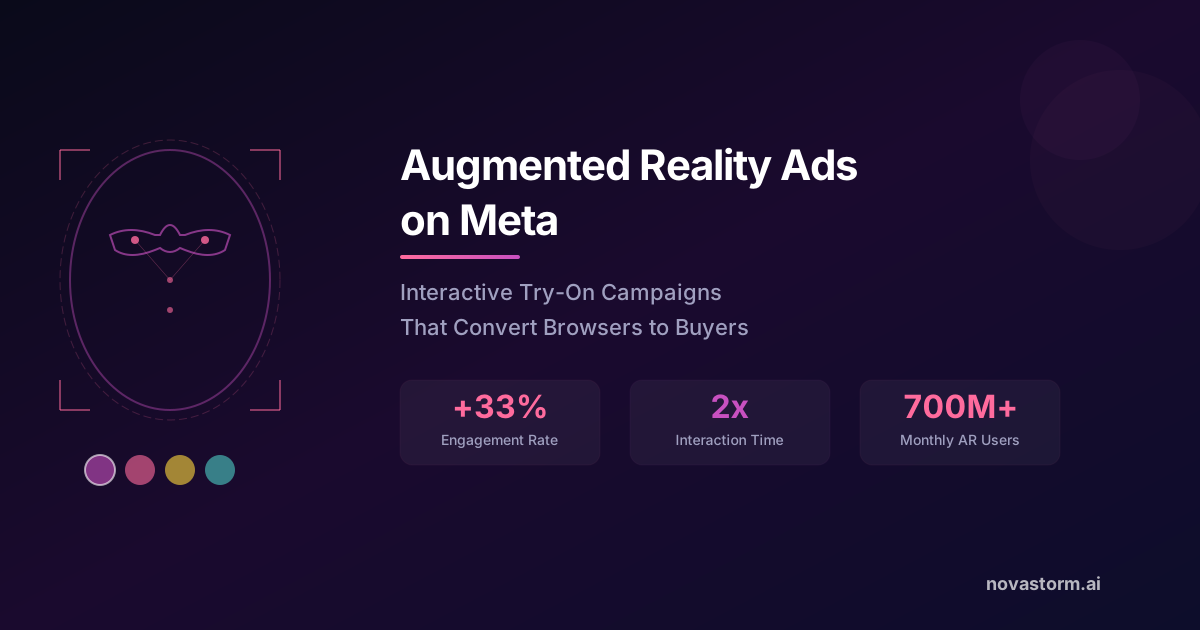
Meta reports that augmented reality ads on Meta generate 33% higher engagement rates and 2x longer interaction times compared to standard video ads. With over 700 million monthly AR users across Instagram and Facebook, the audience is already there. The question is whether your brand is leveraging this format to its full potential.
How AR Ads Work on Meta's Ecosystem
Augmented reality ads on Meta use the device camera to overlay digital elements onto the real world in real time. When a user encounters an AR ad in their feed, they tap to activate the camera experience. The AR effect — built using Meta's Spark AR platform — then renders 3D objects, face filters, or environmental overlays directly in the app.
The technology operates through three core mechanisms: face tracking for beauty and eyewear try-ons, plane detection for furniture and decor placement, and body tracking for apparel visualization. Each mechanism requires different creative assets and optimization approaches.
| AR Mechanism | Use Case | Industries | Avg. Interaction Time |
|---|---|---|---|
| Face Tracking | Makeup, sunglasses, filters | Beauty, eyewear, entertainment | 28 seconds |
| Plane Detection | Furniture, decor, products | Home, retail, automotive | 35 seconds |
| Body Tracking | Clothing, accessories | Fashion, sports, luxury | 22 seconds |
| World Effects | Brand environments, games | CPG, tech, gaming | 42 seconds |
Building Your First AR Try-On Campaign
Creating augmented reality ads on Meta requires a two-track workflow: the AR effect itself (built in Spark AR Studio) and the ad campaign wrapper (configured in Ads Manager). Here is the step-by-step process.
Step 1: Design the AR Effect in Spark AR
Spark AR Studio is Meta's free creation platform for building AR effects. For try-on campaigns, you need 3D models of your products with accurate textures, materials, and proportions. The models should be optimized to stay under 4MB for smooth performance on mid-range devices.
Critical technical specs: use glTF 2.0 format for 3D assets, maintain polygon counts below 50,000 for face effects and 100,000 for world effects, and test on at least five device models before publishing. Effects that lag or glitch destroy the experience and your brand perception.
Step 2: Configure the Campaign in Ads Manager
In Ads Manager, select your objective (Traffic, Conversions, or Brand Awareness work best for AR), then choose the AR Experience ad format at the ad level. Upload a compelling preview video that shows the AR effect in action — this is what users see before they tap to engage. The preview video is your hook; make it demonstrate the most impressive aspect of the AR experience in the first 2 seconds.
Creative Best Practices for AR Try-On Ads
The difference between AR ads that go viral and those that get skipped comes down to creative execution. These seven principles consistently separate high-performing augmented reality ads on Meta from the rest.
- Realistic rendering is non-negotiable — Users judge AR products against real-world expectations. Invest in physically-based rendering (PBR) materials that respond accurately to lighting conditions.
- Guide the interaction — Add on-screen prompts like 'Turn your head' or 'Tap to change color.' Without guidance, 40% of users exit within 5 seconds.
- Offer variety within the experience — Include at least 3-5 product variants (colors, styles) that users can cycle through. This increases interaction time by 60% on average.
- Optimize for sharing — Add a capture button and sharing prompt. AR experiences that generate user-created content produce 5x organic reach amplification.
- Include a clear path to purchase — Every AR effect should end with a CTA that leads to product pages. Place 'Shop Now' buttons that appear after 10 seconds of interaction.
- Design for the demo video — The preview video in the feed must clearly show the AR capability. Use split-screen or before/after formats to communicate the try-on feature instantly.
- Test across skin tones and face shapes — Beauty and eyewear try-ons must work accurately across diverse users. Failing here creates brand damage that outweighs any campaign benefit.
Stop wasting ad budget
NovaStorm AI cuts Meta Ads CPA by 30% on average. Start free.
Performance Metrics and Benchmarks for AR Ads
Augmented reality ads on Meta introduce unique metrics beyond standard advertising KPIs. Understanding these metrics is essential for accurate performance evaluation.
| Metric | Definition | Benchmark (Top 25%) |
|---|---|---|
| Effect Opens | Users who activated the AR camera | 12-18% of impressions |
| Avg. Effect Time | Time spent in the AR experience | 25-40 seconds |
| Capture Rate | Users who took a photo/video | 30-45% of opens |
| Share Rate | Users who shared their capture | 8-15% of captures |
| CTA Click Rate | Clicks on Shop Now post-experience | 15-25% of opens |
| Cost Per Effect Open | CPM divided by open rate | $0.15-$0.40 |
AR ads typically show 40-60% higher CPMs than standard video ads, but the deeper engagement offsets the cost. Calculate your true efficiency using cost per qualified interaction (users who spent 10+ seconds in the effect) rather than CPM alone.
Industry Case Studies: What Works in AR Try-On
The beauty industry leads AR adoption on Meta. Brands running virtual try-on for lipstick, foundation, and eyeshadow consistently report 2.5x higher add-to-cart rates compared to standard product image ads. The key factor is color accuracy — when the AR shade matches the real product within a Delta E of 3 or less, return rates drop by 25%.
Eyewear brands see equally strong results. Virtual sunglasses try-on campaigns generate 80% higher purchase intent scores and reduce the consideration-to-purchase timeline from an average of 14 days to 4 days. The ability to see how frames fit your specific face shape eliminates the primary purchase barrier.
Home furnishing is the emerging frontier. AR ads that let users place a sofa or lamp in their actual room achieve 65% longer interaction times than any other AR category. However, the technical requirements are higher — accurate scale, shadow casting, and occlusion handling are essential for believable placement.
Scaling AR Campaigns: From Pilot to Always-On
Most brands start with a single AR effect tied to a product launch. The transition to always-on AR advertising requires a catalog approach — building a library of AR effects across your product line and rotating them based on performance data.
Create an AR effect pipeline that mirrors your product release calendar. Maintain 3-5 active AR effects at any time, each targeting different audience segments. Use effect-level performance data to inform product development — if a specific color variant drives 3x more captures, that signals real consumer demand.
Automating AR Ad Performance Monitoring
AR campaigns generate more data points than standard ad formats, which makes manual monitoring impractical at scale. The combination of standard ad metrics plus AR-specific engagement metrics means each campaign produces 40-50% more data dimensions.
Automated monitoring becomes critical for identifying when AR effects degrade on specific device types, when interaction times drop below thresholds indicating creative fatigue, and when cost-per-interaction trends exceed profitability targets. Without automation, these signals get buried in the data volume and performance erodes silently.
The brands winning with augmented reality ads on Meta in 2026 are those that treat AR not as a novelty but as a core conversion tool. They invest in realistic product rendering, build diverse effect libraries, measure interaction quality over impression quantity, and use automation to maintain performance at scale. The try-on economy is here — and it is fundamentally reshaping how consumers evaluate products before purchase.
Novastorm AI automates Meta Ads routine — from monitoring to optimization. Learn more at novastorm.ai
Disclaimer: This article was generated with the assistance of AI and reviewed by the NovaStorm AI team. While we strive for accuracy, we recommend verifying specific data points and consulting official sources (linked where available) for critical business decisions.
Ready to automate your Meta Ads?
NovaStorm AI takes full responsibility for your campaigns — from monitoring to optimization.
Get Started FreeRelated Articles
AI Ads Platform vs Hiring a Media Buyer: Cost, Performance, and Control Compared
Should you hire a media buyer or use an AI platform for Meta Ads? Comparing costs, performance, control, and scalability to help you decide.
AI Automation vs Manual Meta Ads Management: Which Approach Wins?
Comparing AI-automated Meta Ads management against manual approaches. See where automation excels, where human oversight matters, and how to combine both.
Competitive Intelligence for Meta Ads: Monitoring Rival Campaigns
Master competitive intelligence for Meta Ads with proven frameworks for monitoring rival campaigns. Learn systematic approaches to track competitor ad spend, creative, and targeting.