

Agency Operations for Meta Ads: Systems and Processes at Scale
Use owned onboarding and launch forms, verify event delivery and access removal, and reconcile agency capacity and reports before approving client work.

Agency operations should make client scope, access, evidence and approval traceable. Client count alone does not define when to hire an analyst or account manager. Build the process around actual workload and review capacity.
A filled onboarding form
The following fictional client, Cedar Shop, has no live account in this example. These rows are a proposed operating form; statuses describe required gates, not completed customer tests.
| Item | Owner and due point | Acceptance evidence |
|---|---|---|
| Scope: one account, market and offer | Account lead before access | Accepted services, exclusions, budget owner and incident route |
| Access inventory | Client administrator before setup | Named people, required permissions, no shared login and exit/review owner |
| Orders and refunds | Client finance before measurement approval | Currency, stable order identity, cost basis and maturity rule |
| Pixel/CAPI where implemented | Client engineer before launch | Controlled purchase receipt, intended browser/server identity and deduplication review |
| Privacy and asset rights | Client authorized reviewers before release | Approved collection purpose and truthful rights-cleared material |
| Exit access | Client administrator at termination/role change | Remove granted partner/user access and revoke applicable integration permissions; verify no remaining grant |
Removing a person in a project tracker does not revoke platform access. Keep an actual permission inventory and verify revocation in each system. Do not copy another client’s customer lists, assets or data into this account.
A launch form with a measurement gate
| Gate | Prepares / independently checks | Approval condition |
|---|---|---|
| Destination and offer | Buyer / commerce reviewer | Correct URL, price, stock, checkout and confirmation |
| Targeting and assignment | Buyer / experiment reviewer | Eligible geography and exclusions; explain intended overlap |
| Purchase receipt | Engineer / analyst | One authorized synthetic order linked to the expected event and ledger |
| Browser/server duplication | Engineer / analyst | Matching intended event identity for copies of one event; confirm actual destination behavior |
| Budget and schedule | Buyer / client budget owner | Currency, exposure cap, date/time zone and loss/incident rule |
| Creative and release | Creative lead / second reviewer | Rights, crop, factual copy and client approval of the exact version |
Audience overlap is not automatically an error. A mutually exclusive experiment requires nonoverlapping assignment; a deliberate prospecting/remarketing design may have its own exclusion policy and delivery tradeoffs. Describe the objective and available configuration instead of prohibiting every overlap.
Where CAPI is implemented, compare server and browser receipts for the same authorized test order, including event name, intended identity, time and value/currency. Verify missing, duplicate and consent-denied cases and reconcile the settled order separately. The Meta server-event SDK defines event identity and time fields; an SDK field existing does not prove an integration delivered or deduplicated an event. This form does not claim NovaStorm provides CAPI.
Stop wasting ad budget
NovaStorm AI cuts Meta Ads CPA by 30% on average. No complex setup required.
Derive utilization and service margin
Hypothetical weekly capacity: 160 team hours, minus 24 administration, 16 mentoring/review and 16 absence/incident buffer, leaves 104 hours for planned delivery. A 96-hour queue fits with eight hours of headroom; a 120-hour queue exceeds it by 16. These are stated assumptions, not a universal 70–80% utilization target or 85% hiring trigger. Avoid counting review hours twice.
For a hypothetical client with $3,000 service revenue, $1,200 allocated labor, $500 contractors and $200 tools, direct service cost is $1,900. Service margin is $1,100 ÷ $3,000 = 36.67%, before overhead and tax. Whether it is acceptable depends on overhead, cash and the chosen profit reserve, not a universal 40% rule. Use recorded hours to choose scope changes, pricing or resources.
A report error and independent correction
| Stage | Illustrative report entry | Owner and required action |
|---|---|---|
| Draft | Spend $1,200 / 60 purchase rows = $20 CPA | Buyer prepares source exports and definitions |
| Independent check | Ten rows duplicate an order and five are cancelled; 45 unique retained orders remain | Analyst reconciles against the authorized ledger and corrects CPA to 26.67 |
| Client version | Spend $1,200; 45 retained orders; CPA $26.67; maturity and refund basis shown | Account lead explains the corrected denominator and unknown outcomes |
| Decision | No scale recommendation until the agreed outcome review is complete | Client budget owner approves the next allowance |
These synthetic numbers demonstrate correction, not a real agency incident. Keep the erroneous version and correction trace available internally; do not silently replace a report after a client decision. A Wednesday draft, Thursday review and Friday delivery is one scheduling choice, with actual time budgeted for unresolved errors.
A proposed NovaStorm workflow prepares one client’s materials as paused campaign and local ad-set drafts for named human review. Keep the onboarding, multi-client permission inventory, reports and approvals in the agency’s verified operating systems. No multi-client automation, client approval system or measured reporting-time reduction is claimed. The client onboarding guide and workload staffing guide develop those decisions.
Published by NovaStorm AI. Planning examples are illustrative assumptions, not measured customer results.
Disclaimer: This article was generated with the assistance of AI and reviewed by the NovaStorm AI team. While we strive for accuracy, we recommend verifying specific data points and consulting official sources (linked where available) for critical business decisions.
Ready to automate your Meta Ads?
NovaStorm AI takes full responsibility for your campaigns — from monitoring to optimization.
Start NowMore on Agency operations and careers
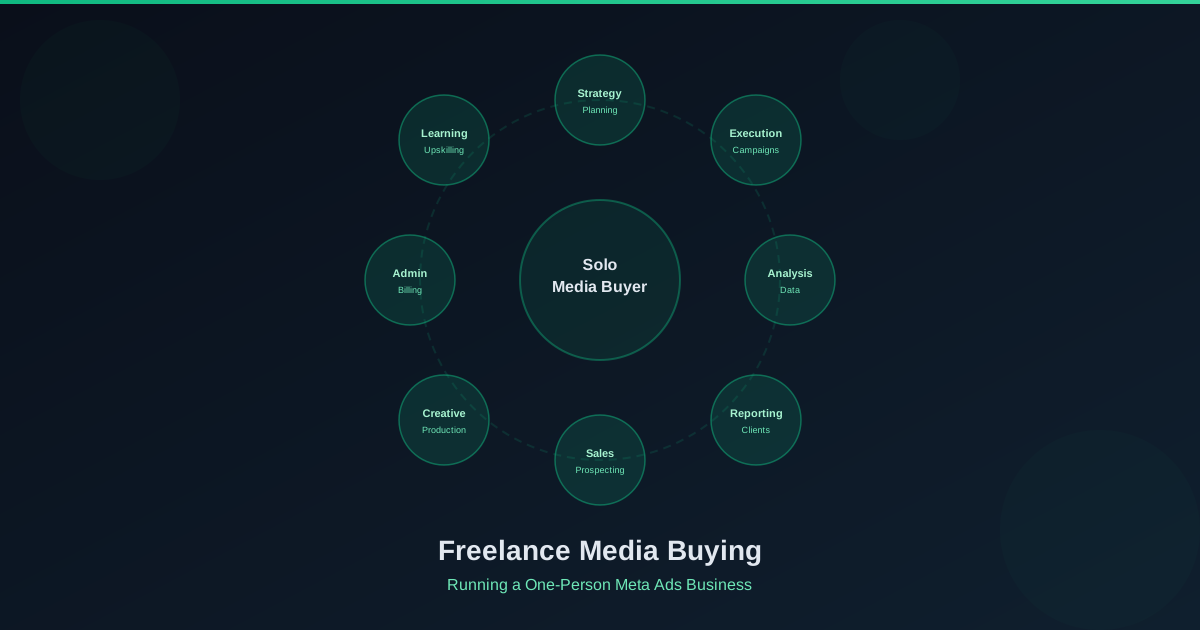
Freelance Media Buying: How to Run a One-Person Meta Ads Business
Price a solo Meta Ads service from actual capacity and costs, define a revenue bonus precisely and make client approval part of delivery.
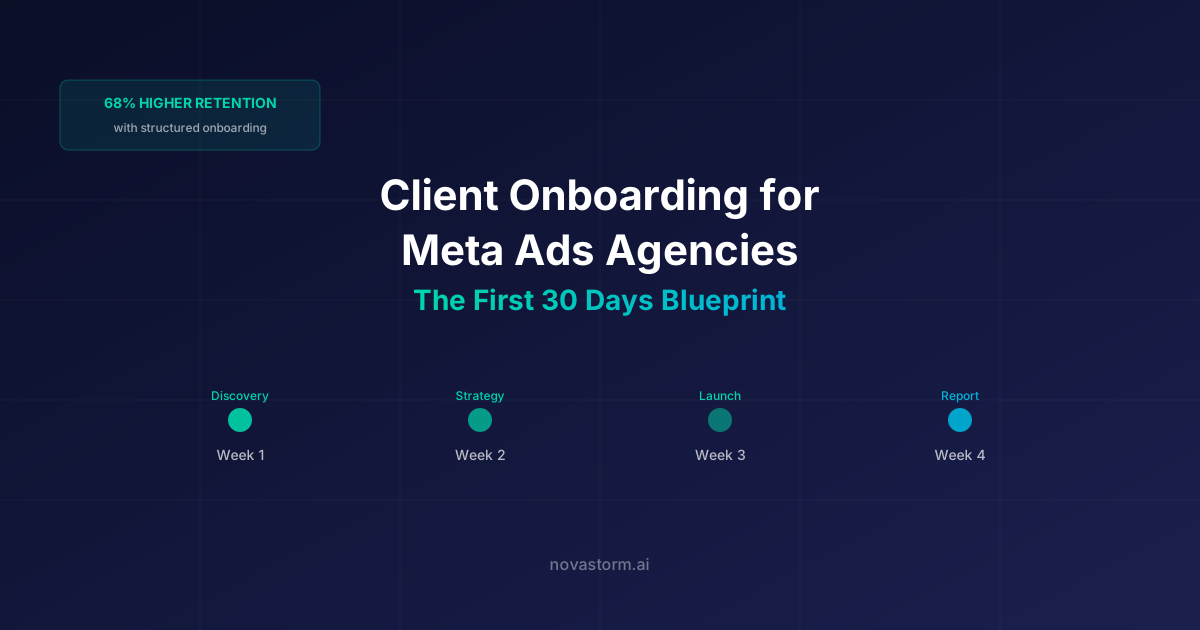
Client Onboarding for Meta Ads Agencies: First 30 Days
Onboard Meta clients with filled discovery, task-based access and expectations documents, launching only after events and approvals are ready.
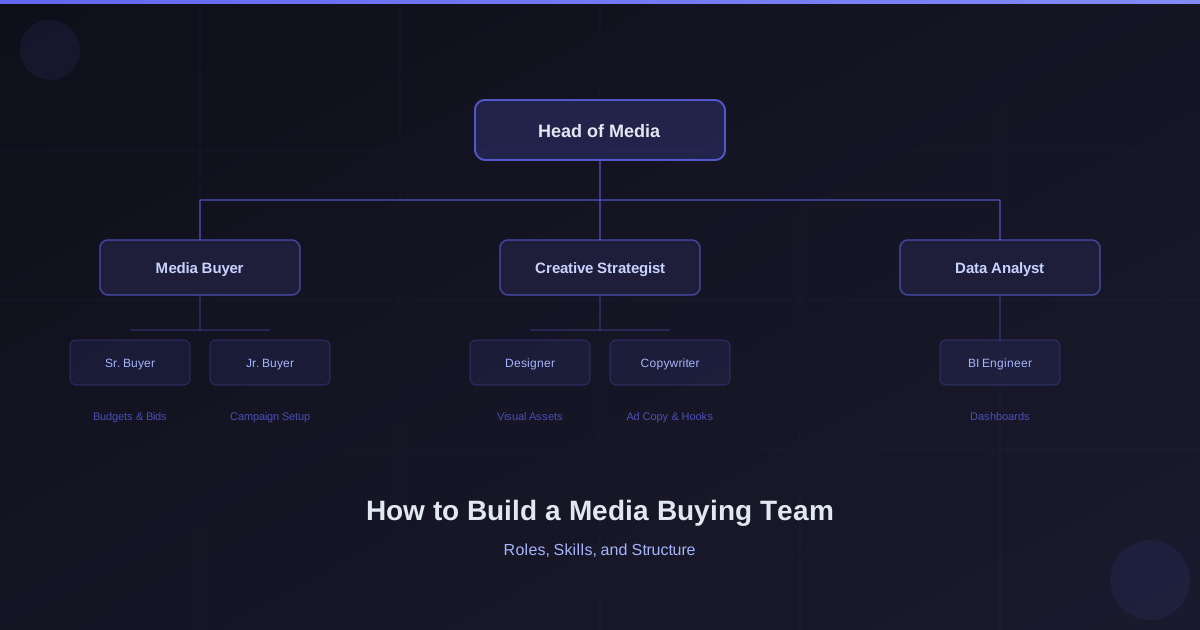
How to Build a Media Buying Team: Roles, Skills, and Structure
Size a media buying team from workload and hiring cost, define approval responsibilities and train new buyers before granting live budget authority.

Meta Ads Pricing Models: How to Price Your Agency Services
Price Meta agency work from scoped hours and loaded costs, with inspectable bonus terms and measured campaign-preparation efficiency.